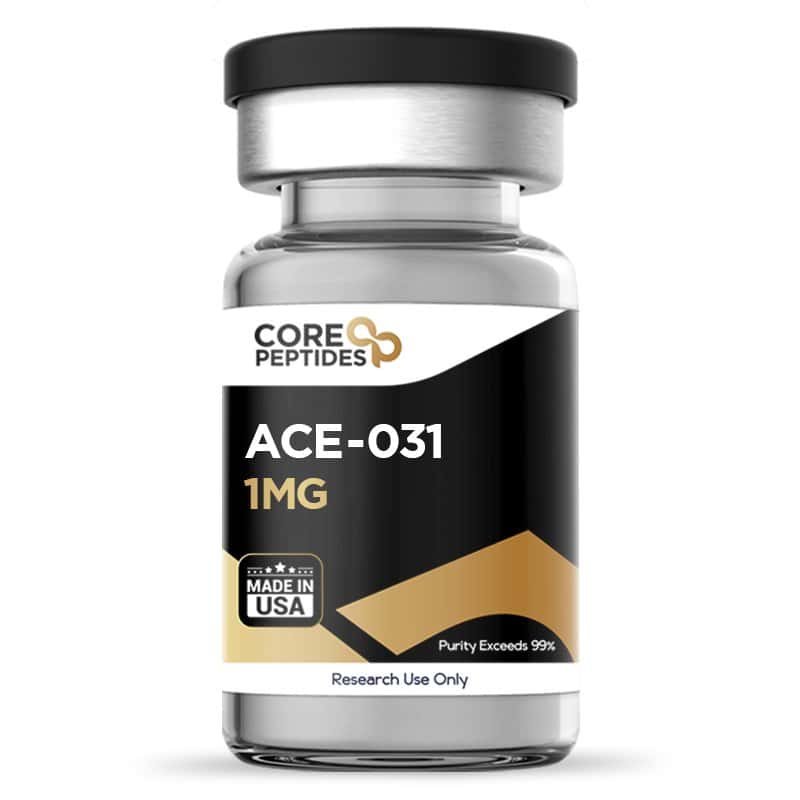
ACE-031 – 1MG
$173.00
ACE-031 is a fusion protein of the activin receptor type IIB extracellular domain and an IgG1 Fc domain (ActRIIB-IgG1). Content size is 1mg, in the form of lyophilized powder. Peptides are sold for laboratory research use only.
Tested by: Vanguard Laboratory, see Certificate of Analysis
SKU: P-ACE031-1
Discount per Quantity
| Quantity | Discount | Price |
|---|
| 5 - 8 | 5% | $164.35 | |
| 9 + | 10% | $155.70 |
What Is ACE-031?
ACE-031 peptide, also known as ActRIIB-IgG1 peptide, appears to be a myostatin inhibitor. In terms of structure, it is a fusion compound consisting of the activin receptor type IIB (ACV2RB) and recombinant immunoglobulin IgG1 FC, which is a form of antibody.(1) Research suggests that this soluble peptide may block the action of circulating myostatin to potentially prevent myostatin from apparently inhibiting the native ACV2RB receptors and thus reducing muscle growth. Myostatin, also known as growth and differentiation factor 8 (GDF8), apparently may be blocked by certain substances termed inhibitors. These inhibitors may target the actions of naturally occurring myostatin, a possible negative regulator of muscle growth primarily found in skeletal muscle tissues. Interestingly, myostatin seemingly has no impact on cardiac or smooth muscle tissues. The discovery of myostatin dates back to 1997, when it was reportedly identified due to its potential inhibitory action on muscle growth, as observed in comparative murine studies.(2) Myostatin may inhibit the activation of murine satellite cells, which are partially committed stem cells within muscle tissue. Additionally, overexpression of myostatin has been suggested to lead to muscle mass reduction in experimental models. Myostatin is thought to bind with the ActR2B receptors with a high affinity, potentially initiating a signaling cascade involving Smad2/3, which is crucial for muscle mass regulation. Other ligands, such as other GDFs and activins, might also bind to ActR2B and potentially regulate muscle growth. These ligands, along with activin receptors, are part of the transforming growth factor-beta (TGF-β) superfamily, which is implicated in controlling tissue growth and differentiation. ACE-031 appears to work by binding with any circulating members from the TGF-β superfamily and, most notably, myostatin. Thus, the ACV2RB receptors in muscle cells remain uninhibited, which is posited to result in the activation of muscle hypertrophy and increase in skeletal muscle tissue size. Besides this, the peptide may have a positive potential for metabolism, fat storage, and bone density.
Specifications
| Name | ACE-031 |
| Other known names | Ramatercept, ActRIIB-IgG1, soluble activin type IIB receptor (ActRIIB-IgG1-Fc) |
| Structure | Fusion protein of the extracellular domain of the activin type IIB receptor (ActRIIB) and the Fc part of IgG1 |
| Molecular formula | C3418H5188N928O1062S38 |
| Molecular weight | 77,489.82 g/mol |
| CAS number | 1169766-01-1 |
| Form | Lyophilized powder |
| Amount per vial | 1 mg |
| Purity | 98.81% (HPLC) |
| Storage | −20 °C, dry, protected from light |
| SKU | P-ACE031-1 |
What Does Research Show About ACE-031?
What Does Research Suggest About ACE-031 and Muscle Hypertrophy?
Key finding: In a placebo-controlled study of a single exposure to ACE-031, mean total body lean mass rose by 3.3% and thigh muscle volume by 5.1% at day 29 in the highest-exposure group; the estimated half-life was 10–15 days.(3)
In an experimental setting, which was structured as a double-blind, placebo-controlled research study, the potential of ACE-031 on muscle tissue was investigated, and a pharmacokinetics analysis was conducted.(3) Based on the pharmacokinetic analysis report on ACE-031, the half-life (T(½)) was estimated to be between 10 to 15 days. The apparent outcome of this study indicated a potential increase in muscle mass attributed to a single test with ACE-031. This conclusion is drawn from observations of changes in muscle tissue, which were quantified using specific measurement techniques such as dual-energy X-ray absorptiometry (DEXA) and MRI after 29 days following the exposure of the peptide. The results suggested that there was a noticeable increase in muscle mass. Specifically, a 3.3% increase in total body lean mass and a 5.1% increase in quadriceps femoris muscle volume were noted. More specifically, the researchers commented that “Statistically significant increases in mean total body lean mass (3.3%; P = 0.03, by DXA) and thigh muscle volume (5.1%; P = 0.03, by MRI) were observed at day 29.” These percentages reflect changes in muscle tissue, potentially indicating the hypertrophy-stimulating capability of ACE-031. Additionally, there were apparent shifts in serum biomarkers, suggesting possible improvements in bone and fat metabolism. Moreover, the scientists also concluded that “Statistically significant changes in serum biomarkers suggest ACE-031 also improved bone and fat metabolism.”
How May ACE-031 Affect Fat Metabolism?
Key finding: In lab models on a high-fat diet, blocking myostatin with a soluble activin type IIB receptor (sActRIIB) reduced the obesity phenotype; lack of myostatin increased fatty acid oxidation and promoted brown fat formation in white adipose tissue.(5)
There may be an increased expression of myostatin in obesity models, according to a review of several scientific studies.(4) For instance, in murine models for studying obesity, the levels of myostatin and its receptor ActR2b appeared to be higher than control models. More specifically, in experimental settings, overexpression of myostatin in murine models appears to correlate with decreased muscle mass, decreased myocardial mass, and increased fat mass. This suggests a potential role of myostatin in promoting fat accumulation and reducing muscle mass. Conversely, depletion of myostatin in certain murine models was linked to a reduction in age-related adipose tissue mass increase and a partial reduction in obesity phenotypes. This suggests that reducing myostatin can mitigate some consequences of obesity. The review also highlights that in mice fed a high-calorie diet, the absence of myostatin appears to result in reduced fat accumulation. This was attributed to two mechanisms:
- Potential Upregulation of Lipolysis and Fatty Acid Oxidation Enzymes: Myostatin deficiency may increase the expression of enzymes like CPT1a and CPT2, enhancing fatty acid oxidation and reducing lipid accumulation.
- Apparent Promotion of Brown (Beige) Fat Formation: The lack of myostatin potentially encourages the conversion of white adipose tissue (an energy storage organ) into brown fat, which is involved in thermogenesis and fat burning.
Consequently, the researchers employed a soluble ActRIIB-Fc similar to ACE-031 in control murine models on a high-fat diet, and the peptide appeared to prevent and reduce obesity.(5)
Could ACE-031 Affect Muscle Contractile Force?
Key finding: In a lab model of Duchenne muscular dystrophy (mdx), 8 weeks of a soluble ActRIIB-Fc increased muscle volume by 33% and maximum and total contractile force by 40% and 24%, while specific force and fatigue resistance were unchanged.(6)
Continuous research by scientists has suggested that the potential of the peptide may extend beyond myostatin inhibition.(6) By potentially preventing oxidative stress in muscle tissues, the peptide may improve the capacity of the muscle tissue to generate a force and in turn, preserve energy and stimulate the muscles toward oxidative respiration. These observations were made in murine models and measured using magnetic resonance imaging (MR imaging) and dynamic [31P]-magnetic resonance spectroscopy ([31P]-MRS). More specifically, the exposure of ACE-031 was linked to an apparent increase in muscle volume by 33% without altering the distribution of muscle fiber types. This suggests that the peptide may promote muscle growth. Additionally, there was an observed increase in basal oxygen consumption (by 22%) and energy expenditure (by 23%) in the murine models, indicating a potential rise in metabolic activity. During a standardized fatiguing exercise, murine models exposed to ACE-031 showed an apparent muscle performance enhancement. Both maximum and total absolute contractile forces were higher (40% and 24%, respectively) than the control group. However, it is important to note that specific force-generating capacity and fatigue resistance seemed unaffected. ACE-031 did not seem to modify metabolic fluxes, adenosine triphosphate (ATP) homeostasis, or contractile efficiency during exercise. However, it appeared to reduce the intrinsic mitochondrial capacity for ATP production. This aspect may suggest a shift in how muscle cells generate energy, although the implications of this finding are not fully clear.
What Does Research Suggest About ACE-031 and Bone Density?
Key finding: In mdx lab models, 7 weeks of a soluble ActRIIB-Fc increased femoral bone volume by about 80% and trabecular number by about 70%, and raised maximum force and stiffness in biomechanical testing.(7)
Another study explored the potential impact of ACE-031 on bone tissue in murine models of Duchenne Muscular Dystrophy (DMD), characterized by muscle degeneration and a heightened risk of fractures.(7) The models were divided into groups based on their activity (running or non-running) and additionally into active or placebo groups. The publication suggested that ACE-031 led to an apparent increase in both body and muscle weights in sedentary and exercising murine models. Importantly, femoral micro-CT analysis suggested an increase in bone volume by about 80% and trabecular number by about +70% in the ACE-031 groups. Running also appeared to improve these bone parameters in the placebo group, but did not further improve trabecular bone structure or volumetric bone mineral density in the treated groups. Additionally, ACE-031 was posited to increase bone mass in vertebral bone tissue, albeit more modestly by about 20-30%. Histological analysis also indicated a potential reduction in osteoclast numbers, and there was data supporting an increased expression of osteoblast marker genes in ACE-031 groups. These findings suggest a potential reduction in bone resorption and an increase in bone formation. Crucially, the researchers commented, “Increased bone mass in femurs translated into enhanced bone strength in biomechanical testing as the maximum force and stiffness were significantly elevated” in the ACE-031 group.
Certificate of Analysis
| Batch / lot | C74101 |
| Test date | 7/15/2026 |
| Testing laboratory | Vanguard Laboratory |
| Method | HPLC-UV/VIS (identity and purity) |
| Purity result | 98.81% |
| Full report | Download the ACE-031 COA (PDF) |
ACE-031 peptide is available for research and laboratory purposes only. We offer free shipping in the US for orders over $200. Please review our Terms and Conditions before ordering.
Frequently Asked Questions
What is ACE-031?
ACE-031 (Ramatercept) is a fusion protein made of the extracellular domain of the activin type IIB receptor (ActRIIB) joined to the Fc part of IgG1. Researchers describe it as a soluble decoy receptor that binds myostatin and related ligands.
How is ACE-031 thought to work?
Research suggests ACE-031 binds circulating myostatin and other ligands of the TGF-β superfamily before they reach the ActRIIB receptors on muscle cells, removing a natural brake on muscle growth.
What is myostatin?
Myostatin, also called growth and differentiation factor 8 (GDF-8), is a member of the TGF-β superfamily expressed in skeletal muscle. Lab models lacking it have much larger muscles, which identified it as a negative regulator of skeletal muscle growth.
How should ACE-031 be stored?
Lyophilized ACE-031 should be stored at −20 °C, dry and protected from light.
Is ACE-031 third-party tested?
Yes. The current batch (C74101) was tested by a third-party laboratory and showed 98.81% purity by HPLC. Its certificate of analysis is available on this page.
References:
- Campbell, C., McMillan, H. J., Mah, J. K., Tarnopolsky, M., Selby, K., McClure, T., Wilson, D. M., Sherman, M. L., Escolar, D., & Attie, K. M. (2017). Myostatin inhibitor ACE-031 treatment of ambulatory boys with Duchenne muscular dystrophy: Results of a randomized, placebo-controlled clinical trial. Muscle & nerve, 55(4), 458–464. https://doi.org/10.1002/mus.25268
- McPherron, A. C., Lawler, A. M., & Lee, S. J. (1997). Regulation of skeletal muscle mass in mice by a new TGF-beta superfamily member. Nature, 387(6628), 83–90. https://doi.org/10.1038/387083a0
- Attie, K. M., Borgstein, N. G., Yang, Y., Condon, C. H., Wilson, D. M., Pearsall, A. E., Kumar, R., Willins, D. A., Seehra, J. S., & Sherman, M. L. (2013). A single ascending-dose study of muscle regulator ACE-031 in healthy volunteers. Muscle & nerve, 47(3), 416–423. https://doi.org/10.1002/mus.23539
- Yang, M., Liu, C., Jiang, N., Liu, Y., Luo, S., Li, C., Zhao, H., Han, Y., Chen, W., Li, L., Xiao, L., & Sun, L. (2023). Myostatin: a potential therapeutic target for metabolic syndrome. Frontiers in endocrinology, 14, 1181913. https://doi.org/10.3389/fendo.2023.1181913
- Zhang, C., McFarlane, C., Lokireddy, S., Masuda, S., Ge, X., Gluckman, P. D., Sharma, M., & Kambadur, R. (2012). Inhibition of myostatin protects against diet-induced obesity by enhancing fatty acid oxidation and promoting a brown adipose phenotype in mice. Diabetologia, 55(1), 183–193. https://doi.org/10.1007/s00125-011-2304-4
- Béchir, N., Pecchi, E., Vilmen, C., Le Fur, Y., Amthor, H., Bernard, M., Bendahan, D., & Giannesini, B. (2016). ActRIIB blockade increases force-generating capacity and preserves energy supply in exercising mdx mouse muscle in vivo. FASEB journal, 30(10), 3551–3562. https://doi.org/10.1096/fj.201600271RR
- Puolakkainen, T., Ma, H., Kainulainen, H., Pasternack, A., Rantalainen, T., Ritvos, O., Heikinheimo, K., Hulmi, J. J., & Kiviranta, R. (2017). Treatment with soluble activin type IIB-receptor improves bone mass and strength in a mouse model of Duchenne muscular dystrophy. BMC musculoskeletal disorders, 18(1), 20. https://doi.org/10.1186/s12891-016-1366-3
Related reading: ACE-031 research in muscle, bone density and energy metabolism.