CJC-1295 & GHRP-2 Blend – 10MG
$84.00
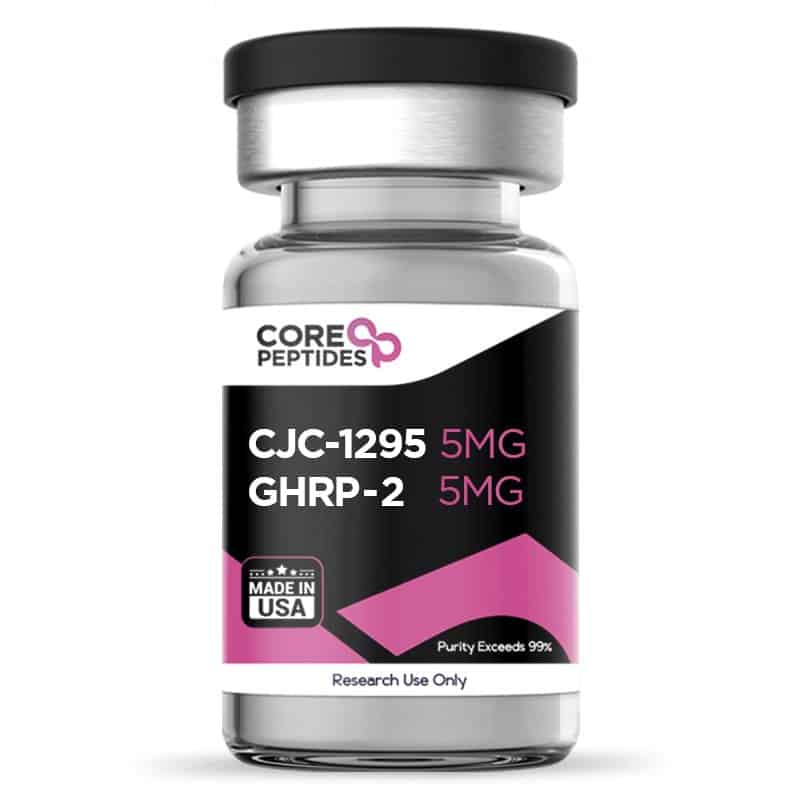
A blend of CJC-1295 without DAC and GHRP-2. Content total size is 10mg (5mg/5mg), in the form of lyophilized powder. Peptides are sold for laboratory research use only.
Tested by: Vanguard Laboratory, see Certificate of Analysis
SKU: CJC-1295-GHRP-2
Discount per Quantity
| Quantity | Discount | Price |
|---|
| 5 - 8 | 5% | $79.80 | |
| 9 + | 10% | $75.60 |
What Is the CJC-1295 & GHRP-2 Blend?
Research indicates that GHRP-2 and CJC-1295 peptides may act on separate receptors, potentially enhancing the release of growth hormone (GH) from the anterior pituitary.
CJC-1295 is a molecular compound that exhibits an apparent binding affinity for the growth hormone-releasing hormone (GHRH) receptors, potentially inducing growth hormone release by pituitary cells. CJC-1295 is derived from GHRH 1-29, which is considered to represent the functional sequence of the initial 29 amino acids of GHRH. Unlike CJC-1295 with DAC, it has no drug affinity complex (DAC) element.(1)
Growth Hormone Releasing Peptide 2 (GHRP-2) is a synthetic hexapeptide composed of six amino acids. Research teams have observed this peptide to bind to the ghrelin or growth hormone secretagogue 1a receptors (GHS-R1a), which are present in the hypothalamus and the pituitary gland. Consequently, GHRP-2 has been suggested by researchers to stimulate the production of growth hormones in pituitary cells that express the GHS-R1a receptor.(2)
By stimulating different receptors through distinct biochemical pathways, these peptides are believed to synergistically elevate GH release from the anterior pituitary beyond the individual capacities of each peptide.
Specifications(3)(4)
| Name | CJC-1295 & GHRP-2 Blend |
| Amount per vial | 10 mg: CJC-1295 without DAC (Mod GRF 1-29) 5 mg, GHRP-2 5 mg |
| Other known names | CJC-1295: CJC-1295 without DAC, Mod GRF 1-29, Modified GRF (1-29); GHRP-2: Pralmorelin, KP-102, GPA-748 |
| Sequence | CJC-1295 (Mod GRF 1-29): Tyr-D-Ala-Asp-Ala-Ile-Phe-Thr-Gln-Ser-Tyr-Arg-Lys-Val-Leu-Ala-Gln-Leu-Ser-Ala-Arg-Lys-Leu-Leu-Gln-Asp-Ile-Leu-Ser-Arg-NH2; GHRP-2: D-Ala-D-2-Nal-Ala-Trp-D-Phe-Lys-NH2 |
| Molecular formula | CJC-1295 (Mod GRF 1-29): C152H252N44O42; GHRP-2: C45H55N9O6 |
| Molecular weight | CJC-1295 (Mod GRF 1-29): 3367.9 g/mol; GHRP-2: 818.0 g/mol |
| CAS number | CJC-1295 (Mod GRF 1-29): 863288-34-0; GHRP-2: 158861-67-7 |
| Synthesis | Solid-phase peptide synthesis, US |
| Form | Lyophilized powder |
| Purity | 98.17% (HPLC) |
| Storage | −20 °C, dry, protected from light |
| SKU | CJC-1295-GHRP-2 |
What Does Research Show About the CJC-1295 & GHRP-2 Blend?
How May the Two Peptides Affect Growth Hormone Secretion?
Key finding: A 2018 review reports that growth hormone secretagogues promote pulsatile release of growth hormone that remains subject to negative feedback, which can prevent supra-therapeutic growth hormone levels.(5)
According to research teams exploring the topic, GHRP-2 may possess a strong affinity towards the growth hormone secretagogue 1a receptor (GHS-R1a) in the hypothalamus and pituitary gland, whereas CJC-1295 may possibly interact with the growth hormone-releasing hormone receptor (GHRH-R) in the pituitary gland. Studies suggest that the influence of this peptide blend may increase plasma growth hormone (GH) levels, indicating their potential to enhance GH release. Possible sustained release of this blend also appears to extend the peptide half-life, potentially prolonging GH secretion compared to individual peptide presentation. As per studies, it has been reported that “basal GH levels may increase by 7.5-fold,” which appears to have contributed to an overall increase in GH secretion by 46%.(1)
Though acting on different receptors, research suggests that synergistically, these peptides may promote “pulsatile release of growth hormones that is subject to negative feedback, and may prevent supratherapeutic levels of GH and their sequelae” (5)
It has been hypothesized that GHRH-mimetics such as CJC-1295 and the secretagogue GHRP-2 may potentially exhibit synergistic effects in regard to their apparent stimulation of growth hormone secretion. Interestingly, the combination of both GHRH-mimetic and GHRP-2 was observed to induce a 54-fold increase in pulsatile GH secretion compared to controls. Moreover, GHRP-2 appeared to decrease the time to maximal GH secretion with a median time reduction of 43%. GHRP-2 was reported to lead to a 47-fold increase in pulsatile GH secretion, while GHRH-mimetics appear to lead to only a 20-fold increase.(6)
How May GHRP-2 Affect Muscle, Fat and Appetite?
Key finding: In lab models exposed to dexamethasone, GHRP-2 attenuated the rise in the muscle atrophy gene Atrogin-1 and lowered MuRF1 without changing IGF-I levels, and in cultured myocytes it lowered both through the GHS-R1a receptor.(2)
GHRP-2 and CJC-1295 peptides, albeit via different proposed mechanisms, appear to stimulate GH release from the pituitary cells, which may assist with fat loss. Research indicates that CJC-1295 may exhibit a longer half-life compared to endogenous GHRH.
Growth hormone is considered to be able to exert anti-obesity effects through several mechanisms, including lipolysis, utilization of fatty acids as an energy source, and increased fat oxidation. The peptide blend has reportedly also exhibited signs of increased glucose synthesis and reduced glucose uptake, which appears to increase fat utilization and storage. Studies indicate that ghrelin-like peptides such as GHRP-2, “because of its dual effects on … (hGH) and on energy balance,” may “be a critical hormonal signal of nutritional status to the somatotropic axis, playing a role in integrating energy balance with the growth process.” (7)
However, it is important to note that as an apparent ghrelin analog, GHRP-2 may have a similar role, potentially increasing hunger levels. It is hypothesized that the potential appetite-stimulating effects of GHRP-2 are primarily mediated through its interaction with the growth hormone secretagogue receptor (GHSR), specifically GHSR-1a, which is located in various regions such as the hypothalamus, pituitary gland, and stomach. Upon binding to GHSR-1a in the hypothalamus, GHRP-2 is thought to initiate a signal transduction cascade that may lead to the increased production of hunger-inducing neuropeptides, Neuropeptide Y (NPY), and Agouti-related peptide (AgRP). Both NPY and AgRP are suspected to play crucial roles in energy homeostasis and appetite regulation. Concurrently, GHRP-2 could potentially suppress the release of the anorexigenic (appetite-suppressing) hormone, melanocyte-stimulating hormone (α-MSH), thereby tipping the balance towards hunger and stimulating food intake. Additionally, GHRP-2 might influence the mesolimbic reward system, a brain circuitry believed to regulate the desire for palatable food, by activating GHSR-1a. This could hypothetically boost the motivation for food consumption.
Moreover, preliminary research suggests that this peptide may induce mild weight gain.(5) Although GHRP-2 seems to predominantly affect appetite through its interaction with GHSR-1a, it is expected to have intricate effects on overall energy homeostasis due to the widespread distribution of GHSRs and the diverse role of ghrelin. Other hormones, neuronal signals, and factors associated with circadian rhythms and physiological states may also modulate its potential appetite-stimulating effects.
Ultimately, the peptide may possibly increase energy consumption and negate some of the fat-reducing potential of CJC-1295. Yet, the combination of CJC-1295 & GHRP-2 blend may likely enhance the anabolic potential of each of the compounds. Thus, the blend may have a higher potential for research into weight gain and especially lean muscle gain, rather than fat loss research. This potential is hypothetically mediated by the so-called insulin-like growth factor-1.
How May CJC-1295 Affect IGF-1 Levels?
CJC-1295 and GHRP-2 may increase growth hormone levels, thereby binding to specific receptors on liver cells, potentially initiating intracellular signaling events that lead to synthesizing a major anabolic mediator called insulin-like growth factor-1 (IGF-1). The binding of growth hormone might trigger the activation of the Janus kinase-signal transducer and activator of the transcription (JAK-STAT) signaling pathway. The activated STAT proteins may then translocate to the nucleus, where they might bind to specific DNA sequences called response elements, possibly leading to the transcription of the IGF-I gene. The newly synthesized IGF-I is then hypothesized to be released into the circulation, where it could act upon various target tissues.
It seems that IGF-I could be a potent growth-promoting hormone that hypothetically mediates several of the growth and anabolic actions of growth hormone. It is proposed to stimulate the growth and proliferation of cells, tissues, and organs, potentially fostering protein synthesis and cellular growth.
Research studies suggest that even a brief encounter with CJC-1295 may impact mean plasma growth hormone concentrations, potentially leading to a 2- to 10-fold increase for six days or possibly more. It is hypothesized that the peak of growth hormone levels is typically achieved within 1 to 4 hours after introduction. Additionally, CJC-1295 might lead to observable dependent increases in mean plasma IGF-I concentrations by 1.5- to 3-fold for possibly 9 to 11 days.(8) Post introduction, IGF-I levels are suggested to remain elevated for at least two weeks in test models with higher exposure. After multiple introductions of CJC-1295, mean IGF-I levels appear to remain above baseline for up to 28 days. Interestingly, data suggests a cumulative action after 2 or 3 exposures to the compound, with potentially elevated levels of growth hormone and IGF-I above baseline on day 14 in laboratory experimental models.
Certificate of Analysis
| Batch / lot | C74116 |
| Test date | 7/22/2026 |
| Testing laboratory | Vanguard Laboratory |
| Method | HPLC-UV/VIS (identity and purity) |
| Purity result | 98.17% |
| Full report | Download the CJC-1295 & GHRP-2 Blend COA (PDF) |
CJC-1295 & GHRP-2 Blend is available for research and laboratory purposes only. We offer free shipping in the US for orders over $200. Please review our Terms and Conditions before ordering.
Frequently Asked Questions
What is in the CJC-1295 & GHRP-2 Blend?
Each 10mg vial contains CJC-1295 without DAC (Mod GRF 1-29) (5mg) and GHRP-2 (5mg), in the form of lyophilized powder.
Is the CJC-1295 in this blend with or without DAC?
Without DAC. The blend contains CJC-1295 without DAC, also known as Mod GRF 1-29.
How do the two peptides in the blend differ?
CJC-1295 (Mod GRF 1-29) is a GHRH analog that acts on the GHRH receptor, while GHRP-2 (Pralmorelin) is a growth hormone secretagogue that acts on the ghrelin receptor (GHS-R1a).
How should the CJC-1295 & GHRP-2 Blend be stored?
The lyophilized blend should be stored at −20 °C, dry and protected from light.
Is the CJC-1295 & GHRP-2 Blend third-party tested?
Yes. The current batch (C74116) was tested by a third-party laboratory and showed 98.17% purity by HPLC. Its certificate of analysis is available on this page.
References:
- Ionescu, M., & Frohman, L. A. (2006). Pulsatile secretion of growth hormone (GH) persists during continuous stimulation by CJC-1295, a long-acting GH-releasing hormone analog. The Journal of clinical endocrinology and metabolism, 91(12), 4792–4797. https://doi.org/10.1210/jc.2006-1702
- Yamamoto, D., Ikeshita, N., Matsubara, T., Tasaki, H., Herningtyas, E. H., Toda, K., Iida, K., Takahashi, Y., Kaji, H., Chihara, K., & Okimura, Y. (2008). GHRP-2, a GHS-R agonist, directly acts on myocytes to attenuate the dexamethasone-induced expressions of muscle-specific ubiquitin ligases, Atrogin-1 and MuRF1. Life sciences, 82(9-10), 460–466. https://doi.org/10.1016/j.lfs.2007.11.019
- National Center for Biotechnology Information (2023). PubChem Compound Summary for CID 56841945. PubChem. https://pubchem.ncbi.nlm.nih.gov/compound/56841945
- National Center for Biotechnology Information (2023). PubChem Compound Summary for CID 6918245, Pralmorelin. PubChem. https://pubchem.ncbi.nlm.nih.gov/compound/Pralmorelin
- Sigalos, J. T., & Pastuszak, A. W. (2018). The safety and efficacy of growth hormone secretagogues. Sexual medicine reviews, 6(1), 45–53. https://doi.org/10.1016/j.sxmr.2017.02.004
- Sinha, D. K., Balasubramanian, A., Tatem, A. J., Rivera-Mirabal, J., Yu, J., Kovac, J., Pastuszak, A. W., & Lipshultz, L. I. (2020). Beyond the androgen receptor: the role of growth hormone secretagogues in the modern management of body composition in hypogonadal males. Translational andrology and urology, 9(Suppl 2), S149–S159. https://doi.org/10.21037/tau.2019.11.30
- Laferrère, B., Hart, A. B., & Bowers, C. Y. (2006). Obese subjects respond to the stimulatory effect of the ghrelin agonist growth hormone-releasing peptide-2 on food intake. Obesity, 14(6), 1056–1063. https://doi.org/10.1038/oby.2006.121
- Teichman, S. L., Neale, A., Lawrence, B., Gagnon, C., Castaigne, J. P., & Frohman, L. A. (2006). Prolonged stimulation of growth hormone (GH) and insulin-like growth factor I secretion by CJC-1295, a long-acting analog of GH-releasing hormone, in healthy adults. The Journal of clinical endocrinology and metabolism, 91(3), 799–805. https://doi.org/10.1210/jc.2005-1536
Related reading: CJC-1295 and GHRP-2 blend research and GHRP-2 research overview.