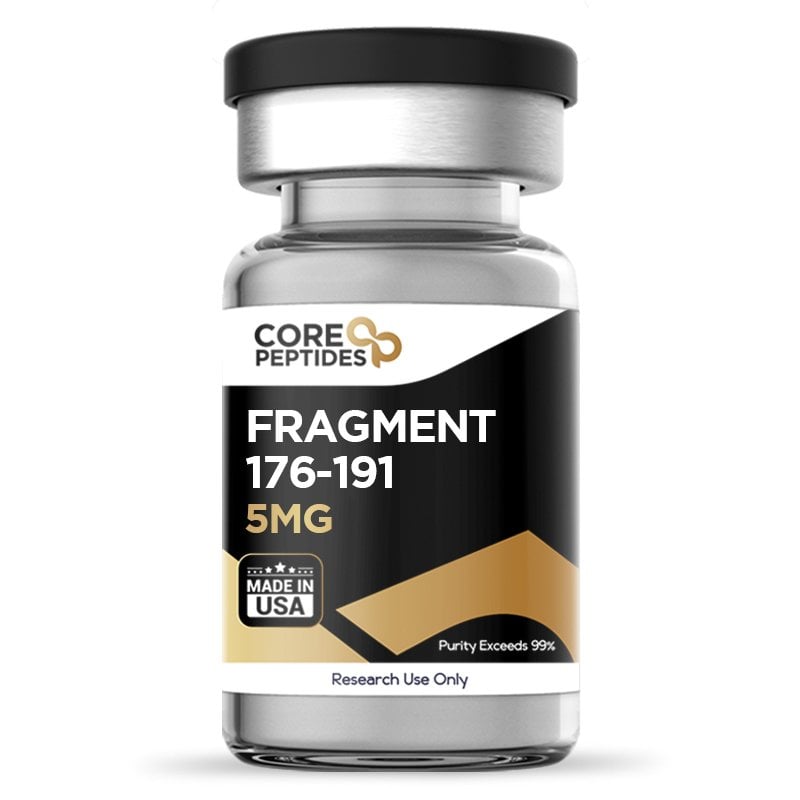
Fragment 176-191 – 5MG
$44.00
Fragment 176-191 is the C-terminal 176-191 fragment of human growth hormone. Content size is 5mg, in the form of lyophilized powder. Peptides are sold for laboratory research use only.
Purity: 99%+ by HPLC (third-party tested)
Tested by: Vanguard Laboratory, see Certificate of Analysis
SKU: P-FRAG176-191
Discount per Quantity
| Quantity | Discount | Price |
|---|
| 5 - 8 | 5% | $41.80 | |
| 9 + | 10% | $39.60 |
What Is Fragment 176-191?
Fragment 176-191 peptide is also known as hGH Fragment 176-191, tyr-hGH 177-191. It is closely related to AOD-9604, and it has been suggested by researchers that it may stimulate weight loss and fat burn in a fashion similar to that of the growth hormone (hGH). hGH is a naturally occurring hormone, which, apart from stimulating growth, as the name suggests, may also stimulate catabolism of adipose tissue and the release of lipids from fat cells. Fragment 176-191 is a small ‘fragment’ of the growth hormone hGH composed of 16 amino acids. This involves the last 16 amino acids of the hGH molecule, which scientists propose to be the “lipolytic fragment” of hGH. Lipolytic, as a term, reflects the purported fat-burning properties of the molecule. To potentially improve the stability of the peptide, the first amino acid in the hGH Fragment 176-191 sequence is also replaced by tyrosine. Thus, the peptide is also labeled as Fragment tyr-hGH 177-191.(1)(2)
How Is Fragment 176-191 Thought to Work?
This peptide could, in theory, aim at the beta-3 adrenergic receptors (ß3-AR), which might, in turn, lead to a potential weight loss action. It is posited that through these receptors, the peptide may encourage fat burning in adipose tissue and foster ‘thermogenesis’ in skeletal muscle cells. In a study involving obese murine models exposed to the peptide for two weeks, there seemed to be an apparent decrease in weight, including a reduction in excess fat. These observations are thought to be linked to a rise in the activity of lipolytic beta-3 adrenergic receptors, hinting that the peptide’s actions could be connected to the beta-adrenergic pathway. The researchers commented that Fragment 176-191 may be “capable of increasing the repressed levels of beta(3)-AR RNA in obese mice to levels comparable with those in lean mice.” Unfortunately, the data may not be conclusive, as the research on murine models with disabled lipolytic receptors suggested that the peptide still led to apparent weight loss, suggesting its actions might not solely rely on these receptors. Thus, it was also considered that the peptide might help burn fat through mechanisms like energy expenditure and fat oxidation, though this remains an area for further investigation.(3)
As mentioned, the presence of tyrosine at the N-terminus of the fragment increases the stability of the peptide. In addition, there appears to be a naturally occurring disulfide bridge between the two cysteine amino acids in the molecule of hGH and hGH Fragment 176-191. This bridge appears to further stabilize the molecule and may increase its resistance against degradation in various environments, including stomach acid.(4)(5)
Specifications
| Name | Fragment 176-191 |
| Other known names | hGH Fragment 176-191, Tyr-hGH (177-191), lipolytic fragment |
| Sequence | Tyr-Leu-Arg-Ile-Val-Gln-Cys-Arg-Ser-Val-Glu-Gly-Ser-Cys-Gly-Phe (16 amino acids) |
| Molecular formula | C78H125N23O23S2 |
| Molecular weight | 1817.1 g/mol |
| Synthesis | Solid-phase peptide synthesis, US |
| Form | Lyophilized powder |
| Amount per vial | 5 mg |
| Purity | >99% (HPLC) |
| Storage | −20 °C, dry, protected from light |
| SKU | P-FRAG176-191 |
What Does Research Show About Fragment 176-191?
How May Fragment 176-191 Affect Fat Cells?
Key finding: In obese lab models, 14 days of exposure to AOD 9604 (Tyr-hGH 177-191) reduced body weight and body fat and raised beta(3)-adrenergic receptor RNA to levels comparable with those in lean models; in beta(3)-AR knock-out models, AOD 9604 still increased energy expenditure and fat oxidation in an acute experiment, suggesting that its lipolytic action is not mediated directly through this receptor.(3)
As mentioned, Fragment 176-191 is believed to potentially increase fat burning through different mechanisms, which may include the upregulation of the beta-3 adrenergic receptors. More specifically, the peptide might elevate the expression levels of beta(3)-AR RNA in fat cells. This suggests that Fragment 176-191 may influence signaling pathways or transcription factors that enhance the production of beta-3 adrenergic receptor mRNA, leading to increased synthesis of the beta-3 adrenergic receptors protein. With more beta-3 adrenergic receptors present on the surface of adipocytes (fat cells), the cells may become more sensitive to lipolytic signals. This posits that even though Fragment 176-191 may not directly activate beta-3 adrenergic receptors, the increased number of receptors might amplify the natural lipolytic response to endogenous catecholamines (like adrenaline), which are suggested to engage these receptors directly. Fragment 176-191 might also activate other cellular signaling mechanisms that indirectly boost fat burning. For example, it may influence pathways that either upregulate the expression of enzymes involved in the lipolysis process or enhance the cellular response to lipolytic signals by modulating the activity of secondary messengers within the cell.
This has been explored by clinical trials, the most notable of which was METAOD005. This trial was initiated to explore the possible fat-burning action of a peptide. 300 test subjects were involved in this investigation, which lasted 12 weeks. There were six groups, including one control group and five Fragment 176-191 groups. It was suggested that one of the Fragment 176-191 groups experienced an apparent decrease in body weight, potentially by around 5.7 pounds. Moreover, it was posited that the peptide may have possibly contributed to improvements in the cholesterol levels and glucose tolerance of these participants.(6)
What Does Research Suggest About Cartilage Regeneration?
Key finding: In a collagenase-induced knee osteoarthritis lab model, weekly intra-articular AOD 9604, a peptide closely related to Fragment 176-191, lowered cartilage degeneration scores, and AOD 9604 combined with hyaluronic acid was more effective than either alone and shortened lameness.(7)
Some researchers have posited that Fragment 176-191 peptide may have some of the proposed regenerative properties of hGH, in addition to its apparent fat-burning potential. To explore these potential impacts of Fragment 176-191 peptide, researchers used a knee osteoarthritis model caused by collagenase. The experimental models were introduced with type II collagenase to apparently induce damage to the knee cartilage. Following this, for a period of 4 weeks, the models were split into four groups including saline (Group 1), hyaluronic acid (Group 2), Fragment 176-191 peptide (Group 3), and a combination of Fragment 176-191 peptide with hyaluronic acid (Group 4). The severity of the cartilage damage was evaluated through both morphological and histopathological analysis, and the degree of lameness was observed 8 weeks after the beginning of the trial. The researchers commented, “Mean gross morphological and histopathological scores were significantly higher in Group 1 than in Groups 2, 3, and 4, and the scores were significantly lower in Group 4 than in Groups 2 and 3. The lameness period in Group 4 was significantly shorter than those in Groups 1, 2, and 3.” This suggested that both hyaluronic acid and Fragment 176-191 peptide may be better than saline in stimulating an apparent cartilage regeneration, and the best research outcome may be achieved with a combination of Fragment 176-191 peptide and hyaluronic acid.(7)
How May Fragment 176-191 Affect Blood Glucose?
In one study,(8) several synthetic hGH peptides, including Fragment 176-191, were presented in normal functioning murine models to determine its potential on glycogen metabolism. Upon delivery, it was reported that the peptide appeared to induce a slight increment in levels of blood glucose and lactate, with a slight reduction in the ratio of glycogen synthase in muscle, adipose tissues, and the liver. It was suggested that this outcome was due to the peptide’s apparent action of converting the enzymes from their active state to inactive state, as the total synthase levels appeared to remain at constant concentrations.
Certificate of Analysis
| Batch / lot | C74128 |
| Test date | 7/22/2026 |
| Testing laboratory | Vanguard Laboratory |
| Method | HPLC-UV/VIS (identity and purity) |
| Purity result | 99.08% |
| Full report | Download the Fragment 176-191 COA (PDF) |
Fragment 176-191 peptide is available for research and laboratory purposes only. We offer free shipping in the US for orders over $200. Please review our Terms and Conditions before ordering.
Frequently Asked Questions
What is Fragment 176-191?
Fragment 176-191 is a synthetic peptide based on the C-terminal end of human growth hormone (amino acids 176-191), the region researchers call its lipolytic fragment. In this form the first amino acid is replaced by tyrosine (Tyr-hGH 177-191).
What has Fragment 176-191 been studied for?
Studies in lab models have examined Fragment 176-191 and the closely related AOD 9604 in fat metabolism and beta-3 adrenergic receptor expression, cartilage regeneration and glucose metabolism.
What is the molecular weight of Fragment 176-191?
Fragment 176-191 has the molecular formula C78H125N23O23S2 and a molecular weight of approximately 1817.1 g/mol.
How should Fragment 176-191 be stored?
Lyophilized Fragment 176-191 should be stored at −20 °C, dry and protected from light.
Is Fragment 176-191 third-party tested?
Yes. The current batch (C74128) was tested by a third-party laboratory and showed >99% purity by HPLC. Its certificate of analysis is available on this page.
References:
- Cox, H. D., Smeal, S. J., Hughes, C. M., Cox, J. E., & Eichner, D. (2015). Detection and in vitro metabolism of AOD9604. Drug testing and analysis, 7(1), 31–38. https://doi.org/10.1002/dta.1715
- Heffernan, M., Summers, R. J., Thorburn, A., Ogru, E., Gianello, R., Jiang, W. J., & Ng, F. M. (2001). The effects of human GH and its lipolytic fragment (AOD9604) on lipid metabolism following chronic treatment in obese mice and beta(3)-AR knock-out mice. Endocrinology, 142(12), 5182–5189. https://doi.org/10.1210/endo.142.12.8522
- Heffernan, M., Summers, R. J., Thorburn, A., Ogru, E., Gianello, R., Jiang, W. J., & Ng, F. M. (2001). The effects of human GH and its lipolytic fragment (AOD9604) on lipid metabolism following chronic treatment in obese mice and beta(3)-AR knock-out mice. Endocrinology, 142(12), 5182–5189. https://doi.org/10.1210/endo.142.12.8522
- Stier, H., Vos, E., & Kenley, D. (2013). Safety and tolerability of the hexadecapeptide AOD9604 in humans. Journal of Endocrinology and Metabolism, 3(1-2), 7–15. https://doi.org/10.4021/jem157w
- Moré, M. I., & Kenley, D. (2014). Safety and metabolism of AOD9604, a novel nutraceutical ingredient for improved metabolic health. Journal of Endocrinology and Metabolism, 4(3), 64–77. https://doi.org/10.14740/jem213w
- Valentino, M. A., Lin, J. E., & Waldman, S. A. (2010). Central and peripheral molecular targets for antiobesity pharmacotherapy. Clinical pharmacology and therapeutics, 87(6), 652–662. https://doi.org/10.1038/clpt.2010.57
- Kwon, D. R., & Park, G. Y. (2015). Effect of intra-articular injection of AOD9604 with or without hyaluronic acid in rabbit osteoarthritis model. Annals of clinical and laboratory science, 45(4), 426–432. https://pubmed.ncbi.nlm.nih.gov/26275694/
- Ma, G. Y., Macaulay, S. L., Maggs, J. A., Armstrong, J. M., & Bornstein, J. (1982). The mechanism of the hyperglycaemic action of synthetic peptides related to the C-terminal sequence of human growth hormone. Biochimica et biophysica acta, 716(3), 400–409. https://doi.org/10.1016/0304-4165(82)90033-2
Related reading: Fragment 176-191: metabolic and regenerative research and Fragment 176-191 and body weight studies.