GHRP-6 – 5MG / 10MG
Price range: $20.00 through $29.00
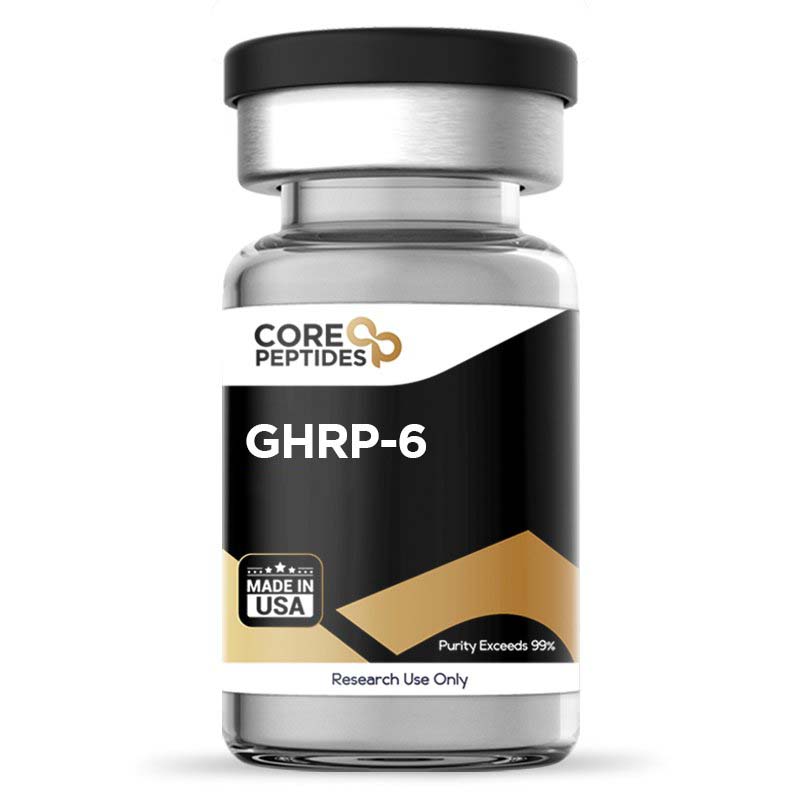
GHRP-6 is a synthetic growth hormone releasing hexapeptide. Content size is 5mg or 10mg, in the form of lyophilized powder. Peptides are sold for laboratory research use only.
Purity: 99%+ by HPLC (third-party tested)
Tested by: Vanguard Laboratory, see Certificate of Analysis
SKU: P-GHRP-6
Discount per Quantity
| Quantity | Discount | Price |
|---|
| 5 - 8 | 5% | Price range: $19.00 through $27.55 | |
| 9 + | 10% | Price range: $18.00 through $26.10 |
What Is GHRP-6?
Growth hormone releasing hexapeptide, or GHRP-6, belongs to a group of synthetic peptides developed with the potential to stimulate the secretion and regulate growth hormone levels. Similar to most such peptides, GHRP-6 is an analog of the naturally occurring opioid peptide and neuromediator called met-enkephalin. Yet, researchers suggest it may lack the opioid activity generally associated with these enkephalins.(1) Instead, GHRP-6 appears to interact with the so-called growth hormone secretagogue receptors (GHS-Rs) which eventually turn out to be ghrelin receptors. Thus, the peptide may also be defined as growth hormone secretagogue (GHS). It is a small, low molecular weight, synthetic peptide, which has been researched for its potential in growth hormone stimulation.(2)
Initially, growth hormone releasing peptides (GHRP) were developed with the intention of mimicking the mechanism of action of growth hormone releasing hormones (GHRHs). When GHRH was first isolated in 1984, scientists hypothesized that these compounds might operate differently; with GHRPs exhibiting an apparent affinity to bind with ghrelin receptors.(3) Ghrelin is also known as the hunger hormone, and it is naturally produced by the stomach when empty. Researchers suspected that GHRPs, like the endogenously found hormone ghrelin, may appear to govern action via hypothalamic stimulation and may have the potential to influence various functions, including metabolism and nutrient absorption.
How Is GHRP-6 Thought to Work?
Research was conducted to determine if GHRP-6 requires endogenous GHRH presence in order to exert its potential. In one study,(4) the researchers evaluated the impact of GHRP-6 exposure following either GHRH antagonist or saline presence in the research models. Blood samples were collected incrementally for the next few hours and the concentrations of growth hormones was measured. Following the study, the researchers suggested that hGH levels were lower in models presented with GHRH antagonist. They posited further that endogenous GHRH may be necessary for GHRP-6 to exert potential action.
While the mechanism of GHRP-6 remains under study,(4) further research studies have suggested that GHRPs may act by binding with two receptors, GHS-R1a, and CD36. In addition to hGH release, GHRP-6 also appears to have the potential to reduce cellular death through binding with CD36 receptors, possibly stimulating prosurvival cellular pathways.(2) This remains under investigation.
Earlier it was hypothesized that GHRP-6 may work through a double mechanism, producing possible activities at the pituitary gland and hypothalamus. In a study to investigate this mechanism of action,(5) two research model groups were evaluated, one group of hypothalamus-pituitary disconnection and one control model. Each subject was either presented GHRH, GHRP-6, or a combination of both. After presentation, the hGH levels were measured in all. In the subjects, GH after GHRH was similar to controls (423), after GHRP-6 alone it was blocked (97) and after GHRH plus GHRP-6 it was increased (745). These results appeared to be converse in the research models of hypothalamic pituitary disconnection, with the least levels of HGH reported in those exposed to both GHRP-6 and GHRH. The GHRH subjects appeared to have the same levels of hGH as controls, whereas the hGH levels were reportedly reduced in models exposed to GHRP-6 alone. Two hypotheses were extended by the researchers from this study – first, GHRP-6 action may be induced primarily in the presence of GHRH and second, that GHRP-6 may act on hypothalamic pituitary axis in order to produce its potential.
Furthermore, researchers posited that GHRPs such as Hexarelin may potentially show an affinity toward CD36 receptors. These receptors are thought to fulfill various functions, such as possibly playing a part in lipid metabolism by acting as a scavenger receptor for lipids, aiding in their absorption, and possibly influencing immune responses by controlling phagocytosis and inflammation. The pathways involving CD36 might also have a role in the regulation of angiogenesis.(6)
Specifications
| Name | GHRP-6 |
| Other known names | Growth hormone-releasing peptide-6, growth hormone-releasing hexapeptide, SKF-110679 |
| Sequence | His-D-Trp-Ala-Trp-D-Phe-Lys-NH2 (6 amino acids) |
| Molecular formula | C46H56N12O6 |
| Molecular weight | 873.0 g/mol |
| CAS number | 87616-84-0 |
| Synthesis | Solid-phase peptide synthesis, US |
| Form | Lyophilized powder |
| Amount per vial | 5 mg or 10 mg |
| Purity | >99% (HPLC) |
| Storage | −20 °C, dry, protected from light |
| SKU | P-GHRP-6 |
What Does Research Show About GHRP-6?
What Does Research Suggest About Hypothyroidism?
Hypothyroidism is typically characterized by reduced levels of growth hormone secretion. The main aim of this study(7) was to determine whether GHRP-6, a supposed hGH release-stimulating agent, might be used to mitigate hGH level reduction. Research models of hypothyroidism were evaluated following random exposure to three different tests of GHRH, and GHRP-6, and GHRH plus GHRP-6. Following the completion of the study, it was observed by the researchers that the models exposed to GHRP-6 alone and with combination of GHRP-6 and GHRH appeared to induce significantly higher levels of growth hormones than GHRH alone. The possible reasoning behind this is that GHRP-6 may differ from GHRH, with the potential as a functional antagonist of somatostatin at the pituitary level, which may be potentially why GHRP-6 may exert possibly increased action on hypothyroidism compared to GHRH.
How May GHRP-6 Affect Cortisol Release?
In this study,(8) the action of GHRP-6 peptide on the hormone release and sleep electroencephalogram (EEG) during the night time was studied. Research models were exposed with either the GHRP-6 peptide or a placebo. After the peptide, it was observed by the researchers that GHRP-6 appeared to induce higher secretion of both growth hormones and cortisol (ACTH) hormones. Throughout the night, particularly during the first half, cortisol hormone release and stage 2 sleep appeared to be enhanced, while the other sleep EEG variables remained apparently unchanged. This study suggested that not only may GHRP-6 possibly induce growth hormone release, but it also may act on the hypothalamus and pituitary gland axis, mobilizing cortisol hormone release.
What Does Research Suggest About Organ Failure?
Key finding: In a liver ischemia/reperfusion model of multiple organ failure, GHRP-6 given beforehand reduced hepatic and intestinal damage, neutrophil infiltration and lipid peroxidation by 50–85%, with an additional benefit when combined with epidermal growth factor; it tripled the migration rate of intestinal epithelial cells.(9)
The main goal of this study(9) was to determine the action of GHRP-6, either alone or in combination with epidermal growth factor (EGF), on multiple organ failure. The first iteration of this study was conducted on the experimental models of injury and multiple organ failure, while the second iteration of the study was conducted on rat intestine and colonic cancer cells. The first study suggested that GHRP-6 may impact the gut epithelial cells and increase cell migration by three times a control rate, without an apparent impact on cell proliferation. In the second model, multiple organ failure caused severe hepatic and intestinal damage and lipid peroxidation. Presentation of GHRP-6 appeared to reduce these damages by a reported 50-85%, with additional activity when GHRP-6 was presented in combination with EGF.
How May GHRP-6 Affect Gastrointestinal Transit?
Key finding: In diabetic lab models with delayed gastrointestinal transit, GHRP-6 accelerated gastric emptying and intestinal transit but not colonic transit, and atropine blocked these prokinetic actions.(10)
The main aim of this study(10) was to investigate the potential of GHRP-6 on delayed gastrointestinal (GI) transit induced by diabetes. An experimental mouse model, with alloxan-induced diabetes, was used for this study. Alloxan is a synthetic uric acid derivative compound, commonly used for experiments, which induces diabetes upon presentation.(11) All experimental mice were presented with GHRP-6 at interval concentrations. Based on the study analysis, researchers posited that the diabetes appeared to reduce the levels of gastric emptying (GE), intestinal transit (IT) and colonic transit (CT) in mice. Upon GHRP-6 presentation, the levels of GE and IT reportedly improved, with no reported fluctuation in CT levels.
What Does Research Suggest About Neuroprotection?
Key finding: One week of exposure to GHRP-6 raised IGF-I mRNA in the hypothalamus, cerebellum and hippocampus of lab models, but not in the cerebral cortex, and stimulated Akt and Bad phosphorylation and antiapoptotic Bcl-2 in the same areas.(12)
The peptide GHRP-6 has been associated by researchers with the safeguarding and restoration of nerve tissue. Research explored its impact on the IGF-1 (insulin-like growth factor-1) system within the brains of murine models.(12) The potential benefits of GH, especially its apparent growth-promoting action, are often believed to be mediated via IGF-1. One study concentrated on the impact of peptides such as GHRP-6 on the brain’s IGF-1 system. Results indicated that exposure to GHRP-6 for a week appeared to elevate IGF-1 mRNA levels in the hypothalamus, cerebellum, and hippocampus, but not in the cerebral cortex, suggesting that GH and GHRP-6 might enhance IGF-1 production in specific areas of the brain. The study also examined the expression of the IGF receptor and IGFBP-2, a protein that binds IGF, finding no notable changes in their activity following the introduction of the peptide. However, the phosphorylation of Akt and the Bcl-2-associated death promoter (BAD) was observed in areas with increased IGF-1 levels, indicating that GH and GHRP-6 may initiate cellular survival pathways in reaction to growth factors. Bcl-2-associated death promoter belongs to the Bcl-2 family of proteins, which is vital for cell death regulation, whereas Akt is a kinase that plays a role in various cellular processes including metabolism, apoptosis, growth, transcription, and migration. There were no observed alterations in MAPK or glycogen synthase kinase-3beta activity. The study noted an increase in the antiapoptotic protein Bcl-2 in areas with raised IGF-1, while the proapoptotic protein Bax levels remained consistent, hinting at a shift towards cell preservation over apoptosis. Lastly, IGFBP-5, linked with neuronal survival, showed significant elevation primarily in the hypothalamus, pointing to a potential neuroendocrine role.
How May GHRP-6 Affect Muscle Tissue?
Key finding: In cultured myoblasts, a GHRP-6-biotin conjugate increased myogenic marker proteins, insulin-like growth factor-1 and collagen type I, and raised metabolic activity (ATP, lactate, lactate dehydrogenase and creatine kinase).(13)
Some research suggests that GHRP-6 may exhibit anabolic capabilities, possibly through a presumed stimulation of growth hormone and IGF-1. An experiment involving cultured myoblast cells indicated that this peptide might enhance the production of myogenic marker proteins, insulin-like growth factor-1, collagen type I, and the metabolic processes within the myoblasts.(13) Therefore, the researchers inferred that GHRP-6 might potentially enhance muscle tissue by promoting the synthesis of collagen type I and crucial proteins.
GHRP-6 may also have anabolic potential through a possible stimulatory effect in GH synthesis, and consequently may induce a possible increase in IGF-1. GHRP-6 has been posited to potentially trigger GH release in a specific manner across multiple species which may be considerably greater than physiological GH synthesis by the anterior pituitary gland cells. The researchers commented that GHRP-6-biotin conjugate apparently elicited a GH secretion with a peak of 15.7 ± 4.4 μg/L and an area under the curve (AUC) of 674 ± 187 μg/L/90mins. These figures appeared to be higher than those elicited by GHRH stimulation that mimics the natural synthesis, and led to an increase of 6.8 ± 1.1 μg/L for the peak and 412 ± 71 μg/L/90mins for the AUC, respectively.(14) Another similar study also reported an apparent GH peak of about 15.4 μg/L produced by the anterior pituitary cells, under the potential influence of the GHRP-6 conjugate, while the the physiological peak in GH levels was reported to have reached a maximum of just 5.5 μg/L.(15)
What Does Research Suggest About Tissue Repair?
Key finding: Topical GHRP-6 reduced inflammatory mediators and fibrotic cytokines in excisional wounds in lab models and, in a hypertrophic scar model, markedly reduced the onset of exuberant scars by activating PPARγ.(16)
As indicated, GHRP-6 is believed to stimulate not only ghrelin (GHS-Rs) receptors, which are linked to GH production, but also CD36 receptors, potentially mediating anti-inflammatory and other advantageous effects. A preclinical study involving rat models exposed to GHRP-6 for 30 days suggested a possibility for faster wound healing and diminished hypertrophic scar development by lessening inflammation and the expression of fibrotic cytokines, pointing to its potential utility in enhancing wound appearance.(16) Similarly, in a separate preclinical investigation, the stimulation of ghrelin receptors was posited to improve wound healing in rats subjected to combined radiation and burn injury, through a reduction in pro-inflammatory agents, particularly TNF-α, and the alteration of signaling pathways related to inflammation and healing.(17) Furthermore, it was reported that following 60 days of GHRP-6 exposure, there was a potential decrease in liver fibrosis and a reduction in fibrogenic factors such as TGF-β and CTGF, with fibrotic areas and nodularity decreasing by 75% and more than 60%, respectively.(18) This indicates the potential for GHRP-6 to possibly mitigate fibrosis and enhance the healing process in experimental settings.
Certificate of Analysis
| Size | 5mg | 10mg |
| Batch / lot | C74135 | C74136 |
| Test date | 7/22/2026 | 7/22/2026 |
| Testing laboratory | Vanguard Laboratory | Vanguard Laboratory |
| Method | HPLC-UV/VIS (identity and purity) | HPLC-UV/VIS (identity and purity) |
| Purity result | 99.01% | 99.24% |
| Full report | Download the GHRP-6 5mg COA (PDF) | Download the GHRP-6 10mg COA (PDF) |
GHRP-6 peptide is available for research and laboratory purposes only. We offer free shipping in the US for orders over $200. Please review our Terms and Conditions before ordering.
Frequently Asked Questions
What is GHRP-6?
GHRP-6 is a synthetic hexapeptide, His-D-Trp-Ala-Trp-D-Phe-Lys-NH2, that acts on the ghrelin receptor (GHS-R1a) to stimulate growth hormone release.
What has GHRP-6 been studied for?
Research has examined GHRP-6 in growth hormone and cortisol release, organ injury, gastrointestinal transit, brain IGF-1 signaling, muscle cells and wound healing.
What is the molecular weight of GHRP-6?
GHRP-6 has the molecular formula C46H56N12O6 and a molecular weight of approximately 873.0 g/mol.
How should GHRP-6 be stored?
Lyophilized GHRP-6 should be stored at −20 °C, dry and protected from light.
Is GHRP-6 third-party tested?
Yes. The current batches were tested by a third-party laboratory: 5mg (C74135) and 10mg (C74136) both showed >99% purity by HPLC. Their certificates of analysis are available on this page.
References:
- Rico, M., Lorenzo, M. T., Pazo, J. A., Vega, F. V., & De la Cruz, L. F. (1999). GHRP-6 in heifer and cow adenohypophisial cells separated by elutriation. Journal of physiology and biochemistry, 55(1), 33–39. https://pubmed.ncbi.nlm.nih.gov/10494658/
- Berlanga-Acosta, J., Abreu-Cruz, A., Herrera, D. G. B., Mendoza-Marí, Y., Rodríguez-Ulloa, A., García-Ojalvo, A., Falcón-Cama, V., Hernández-Bernal, F., Beichen, Q., & Guillén-Nieto, G. (2017). Synthetic growth hormone-releasing peptides (GHRPs): a historical appraisal of the evidences supporting their cytoprotective effects. Clinical medicine insights. Cardiology, 11, 1179546817694558. https://doi.org/10.1177/1179546817694558
- Bowers, C. Y., Reynolds, G. A., & Veldhuis, J. D. (2012). Ghrelin: A history of its discovery. In Ghrelin in health and disease (pp. 1–35). Humana Press. https://doi.org/10.1007/978-1-61779-903-7_1
- Pandya, N., DeMott-Friberg, R., Bowers, C. Y., Barkan, A. L., & Jaffe, C. A. (1998). Growth hormone (GH)-releasing peptide-6 requires endogenous hypothalamic GH-releasing hormone for maximal GH stimulation. The Journal of clinical endocrinology and metabolism, 83(4), 1186–1189. https://doi.org/10.1210/jcem.83.4.4711
- Popovic, V., Damjanovic, S., Micic, D., Djurovic, M., Dieguez, C., & Casanueva, F. F. (1995). Blocked growth hormone-releasing peptide (GHRP-6)-induced GH secretion and absence of the synergic action of GHRP-6 plus GH-releasing hormone in patients with hypothalamopituitary disconnection: evidence that GHRP-6 main action is exerted at the hypothalamic level. The Journal of clinical endocrinology and metabolism, 80(3), 942–947. https://doi.org/10.1210/jcem.80.3.7883854
- Demers, A., McNicoll, N., Febbraio, M., Servant, M., Marleau, S., Silverstein, R., & Ong, H. (2004). Identification of the growth hormone-releasing peptide binding site in CD36: a photoaffinity cross-linking study. The Biochemical journal, 382(Pt 2), 417–424. https://doi.org/10.1042/BJ20040036
- Pimentel-Filho, F. R., Ramos-Dias, J. C., Ninno, F. B., Façanha, C. F., Liberman, B., & Lengyel, A. M. (1997). Growth hormone responses to GH-releasing peptide (GHRP-6) in hypothyroidism. Clinical endocrinology, 46(3), 295–300. https://doi.org/10.1046/j.1365-2265.1997.1270942.x
- Frieboes, R. M., Murck, H., Maier, P., Schier, T., Holsboer, F., & Steiger, A. (1995). Growth hormone-releasing peptide-6 stimulates sleep, growth hormone, ACTH and cortisol release in normal man. Neuroendocrinology, 61(5), 584–589. https://doi.org/10.1159/000126883
- Cibrián, D., Ajamieh, H., Berlanga, J., León, O. S., Alba, J. S., Kim, M. J., Marchbank, T., Boyle, J. J., Freyre, F., Garcia Del Barco, D., Lopez-Saura, P., Guillen, G., Ghosh, S., Goodlad, R. A., & Playford, R. J. (2006). Use of growth-hormone-releasing peptide-6 (GHRP-6) for the prevention of multiple organ failure. Clinical science, 110(5), 563–573. https://doi.org/10.1042/CS20050374
- Zheng, Q., Qiu, W. C., Yan, J., Wang, W. G., Yu, S., Wang, Z. G., & Ai, K. X. (2008). Prokinetic effects of a ghrelin receptor agonist GHRP-6 in diabetic mice. World journal of gastroenterology, 14(30), 4795–4799. https://doi.org/10.3748/wjg.14.4795
- Szabadfi, K., et al. (2007). Therapeutic areas I: Central nervous system, pain, metabolic syndrome, urology, gastrointestinal and cardiovascular. In Comprehensive medicinal chemistry II. Elsevier. https://www.sciencedirect.com/topics/medicine-and-dentistry/alloxan
- Frago, L. M., Pañeda, C., Dickson, S. L., Hewson, A. K., Argente, J., & Chowen, J. A. (2002). Growth hormone (GH) and GH-releasing peptide-6 increase brain insulin-like growth factor-I expression and activate intracellular signaling pathways involved in neuroprotection. Endocrinology, 143(10), 4113–4122. https://doi.org/10.1210/en.2002-220261
- Lim, C. J., Jeon, J. E., Jeong, S. K., Yoon, S. J., Kwon, S. D., Lim, J., Park, K., Kim, D. Y., Ahn, J. K., & Kim, B. W. (2015). Growth hormone-releasing peptide-biotin conjugate stimulates myocytes differentiation through insulin-like growth factor-1 and collagen type I. BMB reports, 48(9), 501–506. https://doi.org/10.5483/bmbrep.2015.48.9.258
- Cordido, F., Peñalva, A., Dieguez, C., & Casanueva, F. F. (1993). Massive growth hormone (GH) discharge in obese subjects after the combined administration of GH-releasing hormone and GHRP-6: evidence for a marked somatotroph secretory capability in obesity. The Journal of clinical endocrinology and metabolism, 76(4), 819–823. https://doi.org/10.1210/jcem.76.4.8473389
- Frieboes, R. M., Murck, H., Maier, P., Schier, T., Holsboer, F., & Steiger, A. (1995). Growth hormone-releasing peptide-6 stimulates sleep, growth hormone, ACTH and cortisol release in normal man. Neuroendocrinology, 61(5), 584–589. https://doi.org/10.1159/000126883
- Mendoza Marí, Y., Fernández Mayola, M., Aguilera Barreto, A., García Ojalvo, A., Bermúdez Alvarez, Y., Mir Benítez, A. J., & Berlanga Acosta, J. (2016). Growth hormone-releasing peptide 6 enhances the healing process and improves the esthetic outcome of the wounds. Plastic surgery international, 2016, 4361702. https://doi.org/10.1155/2016/4361702
- Liu, C., Huang, J., Li, H., Yang, Z., Zeng, Y., Liu, J., Hao, Y., & Li, R. (2016). Ghrelin accelerates wound healing through GHS-R1a-mediated MAPK-NF-κB/GR signaling pathways in combined radiation and burn injury in rats. Scientific reports, 6, 27499. https://doi.org/10.1038/srep27499
- Berlanga-Acosta, J., Vázquez-Blomquist, D., Cibrián, D., Mendoza, Y., Ochagavía, M. E., Miranda, J., … Guillén-Nieto, G. E. (2012). Growth hormone releasing peptide 6 (GHRP6) reduces liver fibrosis in CCl4 chronically intoxicated rats. Biotecnología Aplicada, 29(2), 60–72.
Related reading: Hexarelin vs GHRP-6 and Sermorelin and GHRP-6 research.
GHRP-6 (5mg) – Certificate of Analysis

GHRP-6 (10mg) – Certificate of Analysis