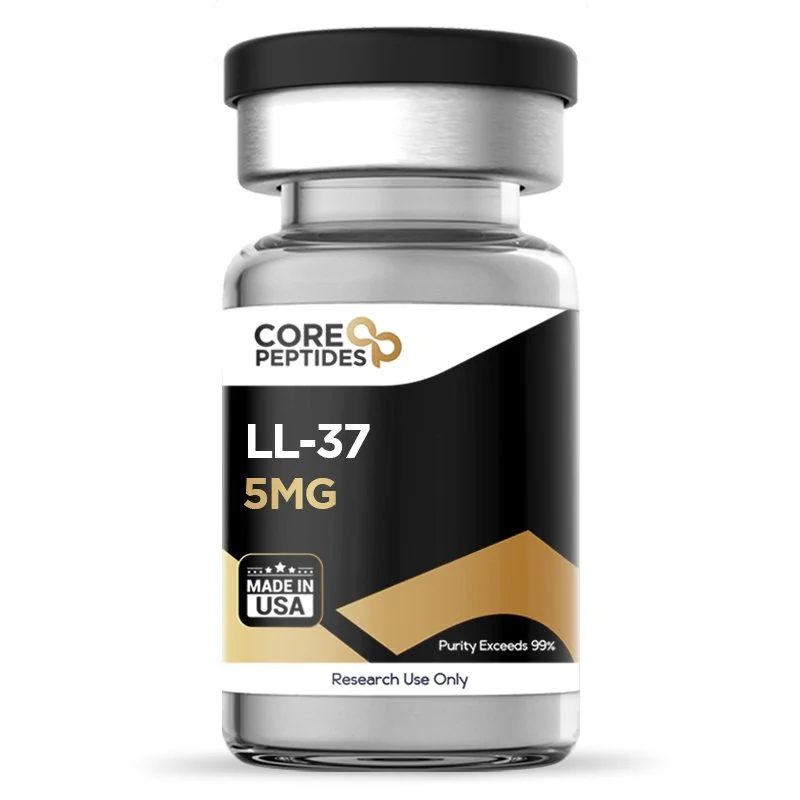
LL-37 – 5MG
$89.00
LL-37 is the 37-amino-acid human cathelicidin peptide, cleaved from hCAP18. Content size is 5mg, in the form of lyophilized powder. Peptides are sold for laboratory research use only.
Purity: 99%+ by HPLC (third-party tested)
Tested by: Vanguard Laboratory, see Certificate of Analysis
SKU: P-LL37-5
Discount per Quantity
| Quantity | Discount | Price |
|---|
| 5 - 8 | 5% | $84.55 | |
| 9 + | 10% | $80.10 |
What Is LL-37?
LL-37, also known as Cathelicidin, is a cationic peptide composed of 37 amino acids and is primarily found in neutrophils.(1) The peptide appears to be produced by the extracellular breakdown of the hCAP18 proteins caused by protease enzymes. Researched for its potential antimicrobial characteristics, the peptide appears to form agglomerates and lipid bilayers, which may prevent it from easily degrading and protect it from enzymatic action.(1)
How Is LL-37 Thought to Work?
Antimicrobial peptides are structured with the potential to fight against bacteria, fungi, and some virus strains. These peptides may interact with targets in a non-specific fashion, which supports researchers’ belief that once the peptide is introduced, pathogens are unable to develop resistance against these peptides.(2)
LL-37 is a α-helical peptide that scientists believe is required to maintain immunity against all microbes.(3) To understand the functioning of the peptide, a peptide model was created as reviewed by Brogden(4) based on the assumption that the peptide might interact directly with the bacterial membrane. This study suggested that the peptide first interacts with the lipids on the bacterial membrane via electrostatic characteristics, followed by lateral diffusion and consequent assembly of the peptide on the membrane. This potential interaction may lead to membrane interference and degradation of the bacterial cell.
Several other studies hypothesize how the peptide interacts with microbial membranes, including pore formation on the membrane(3)(5) and extreme membrane disruption caused by the peptide and lipid complexes.(6) These studies universally suggest that peptides have the potential to interact with the microbial membrane, leading to membrane breakdown.
Specifications
| Name | LL-37 |
| Other known names | Cathelicidin LL-37, ropocamptide, antimicrobial peptide LL-37 |
| Sequence | LLGDFFRKSKEKIGKEFKRIVQRIKDFLRNLVPRTES (37 amino acids) |
| Molecular formula | C205H340N60O53 |
| Molecular weight | 4493.3 g/mol |
| CAS number | 154947-66-7 |
| Synthesis | Solid-phase peptide synthesis, US |
| Form | Lyophilized powder |
| Amount per vial | 5 mg |
| Purity | >99% (HPLC) |
| Storage | −20 °C, dry, protected from light |
| SKU | P-LL37-5 |
What Does Research Show About LL-37?
How May LL-37 Promote Inflammation?
Key finding: LL-37 enabled keratinocytes and macrophages to recognize self non-coding U1 RNA by facilitating its binding to cell-surface scavenger receptors; the resulting interleukin-6 and interferon-beta1 expression depended on this binding and on clathrin-mediated endocytosis.(7)
The main aim of this study(7) was to determine the inflammatory potential of this peptide. Tissue culture was used, half without alteration and the other half with added U1 RNA. U1 RNA is a non-coding RNA released upon tissue injury. LL-37 peptide was then added to both cultures. Upon genetic analysis, it was suggested by the researchers that the culture that was given both U1 RNA and LL-37 peptide stimulated a reportedly significant response towards epidermal inflammation and defense response. The study proposes that the peptide might potentially enhance the immune system’s response to damaged cells by influencing how self-nucleic acids (DNA and RNA) are recognized. This recognition is apparently facilitated when the peptide interacts with specific cellular receptors, including scavenger receptors (SRs), which may lead to clathrin-dependent endocytosis. This process appears critical for the subsequent activation of inflammatory pathways within the cells. Moreover, the study indicates that LL-37 might enable the binding of dsRNA (double-stranded RNA) to these scavenger receptors, which in turn might lead to a series of signaling events culminating in cytokine expression. Notably, the interaction between LL37 and scavenger receptors such as SR-A6 and SR-B1 may be essential for this process, as blocking these receptors with a competitive inhibitor like fucoidan or silencing their expression significantly reduced cytokine production.
Another interesting aspect of the study is the hypothesis that LL-37 may modulate the immune system by potentially altering how intracellular signaling pathways, such as those involving Toll-like receptors (TLR) and the interferon regulatory factors, and may be activated in response to foreign nucleic acids. As detailed in the study, the involvement of clathrin-mediated endocytosis suggests that LL-37 may help orchestrate the entry of these immune-modulating molecules into cells, which is a vital step for triggering an immune response.
What Does Research Suggest About Autoimmunity?
Key finding: A 2013 review discusses how LL-37 modulates immune and inflammatory pathways and how it may contribute to psoriasis, atopic dermatitis, lupus, rheumatoid arthritis and atherosclerosis.(1)
The main aim of this study(1) was to understand the role of LL-37 in models of autoimmunity such as psoriasis. This disease pathogenesis study suggested that endogenous peptide may form complex DNA, increasing interferon mechanisms and more inflammatory responses. This study theorized that LL-37 may be favorable for tissue and wound injury; however, in some cases, LL-37 levels appeared to indicate psoriasis presence. In fact, it might potentially exert anti-apoptotic actions on keratinocytes, which might be linked to the observed cellular proliferation in psoriatic lesions. LL-37 is a naturally occurring antimicrobial peptide that forms part of the immune system, playing various roles in immune responses. This action may potentially contribute to developing the thick, scaly skin that is a hallmark of psoriasis.
While LL-37 has been implicated in promoting inflammation via type I interferon (IFN) pathways, it appears to simultaneously offer a protective action against the activation of the AIM2 inflammasome by cytosolic double-stranded DNA (dsDNA). Cytosolic dsDNA often triggers immune responses that may lead to inflammation. In cases where LL-37 forms complexes with DNA, these complexes seemingly do not promote the production of interleukin-1β (IL-1β), a pro-inflammatory cytokine, nor activate the inflammasome. This implies that LL37 might protect keratinocytes from the inflammatory responses typically triggered by the AIM2 inflammasome in the presence of dsDNA. This dual potential of LL-37 underscores its complex involvement in immune regulation and inflammatory processes.
How May LL-37 Relate to Arthritis?
Key finding: In lab models with pristane-induced arthritis, the cathelicidin rCRAMP (the counterpart of LL-37 in these models) was strongly upregulated in the joints, blood and spleen, and its rise coincided with more cell death, higher interferon-alpha levels and the development of autoantibodies.(8)
The main objective of this study(1)(8) was to evaluate the potential of LL-37 in arthritic joints. A group of rats were used in this study,(8) with one control group and one group experimentally induced with rheumatoid arthritis. Upon inducing the condition, researchers reported an apparent increased regulation of rCRAMP, the rat analog of LL-37 peptide, in inflammatory cells. Researchers suggested that LL-37 peptide might further induce apoptosis of osteoblasts, thereby leading to decreased bone formation in the joints. This study suggested that increased LL-37 levels are characteristic of joint aches and arthritis and may potentially be used for diagnostic purposes.
Besides these, study(1) has suggested that LL-37 elevation is seen in other inflammatory circumstances, including psoriasis, lupus, rheumatoid arthritis, and atherosclerosis. Scientists report that LL-37 activation and the consequent upregulation of interferons are characteristic of inflamed cells. The researchers of this study suggested that the peptide may have potential as an immunomodulatory agent.
What Does Research Suggest About Tissue Repair?
Key finding: In dexamethasone-exposed lab models, topically applied synthetic and recombinant LL-37 increased vascularization and re-epithelialization of wounds; in vitro, recombinant LL-37 neutralized LPS activation of macrophages and induced proliferation, migration and tubule-like structure formation by endothelial cells.(9)
In this study,(9) mice presented with an anti-inflammatory compound were then presented with LL-37 to study the potential of this peptide on angiogenesis and wound healing. The researchers suggested that the peptide mice exhibited an apparent increase in vascularization and skin cell formation. This study suggested that LL-37 has the potential to induce endothelial skin cell proliferation and formation of tubule-like structures, which are both required in angiogenesis mechanisms.
Further, the study indicates that LL37 possibly counteracts the activation of macrophages triggered by lipopolysaccharide (LPS), a component known to provoke immune responses. Furthermore, it seems to foster endothelial cell behaviors essential for wound healing, such as proliferation, migration, and the formation of tubule-like structures, all indicative of angiogenesis. Experiments on catabolism-induced murine models, utilizing both synthetic and recombinant forms of LL-37, suggest that exposure to the peptide may enhance vascularization and re-epithelialization. These observations collectively lead to the hypothesis that the peptide might be crucial in promoting wound regeneration, potentially through its actions on vascularization.
How May LL-37 Affect Cancer Cells?
Key finding: A 2010 review notes that LL-37 overexpression has been linked to the development or progression of breast, ovarian and lung cancers, whereas LL-37 suppresses tumorigenesis in gastric cancer, and that the reasons for these tissue-specific roles remain unclear.(10)
Studies(10) are ongoing to explore the potential of the peptide in cancer cell development. The studies in total found that LL-37 suppresses tumorigenesis in gastric cancer, but its overexpression has been linked to breast, ovarian and lung cancers. These studies have suggested that the peptide may inhibit gastric cancer cell proliferation by activating the bone morphogenetic protein signaling system. The main aim of this research was to consider the potential of LL-37 as an immunotherapeutic agent or consider the potential of LL-37 peptide as an adjuvant in eliminating cancer cells from the host system. CpG oligodeoxynucleotides are widely considered to be immunotherapeutic compounds as they appear to promote the tumor-suppressing activity. When presented with LL-37, researchers reported that the peptide LL-37 appeared to increase the CpG oligodeoxynucleotides sensitivity in lymphocytes.
What Does Research Suggest About the GI Tract?
Key finding: In colonic subepithelial myofibroblasts, the TLR-3 ligand poly(I:C) induced LL-37 expression and secretion through TRIF, TRAF6 and TAK1 signaling, and LL-37 suppressed LPS-induced interleukin-6 and interleukin-8 expression.(12)
LL-37 may potentially impact ailments associated with the gastrointestinal (GI) tract. There appears to be an increased expression of LL-37 in research models of gastrointestinal ulcers. This upregulation might be mediated through the activation of Toll-like receptor 3 (TLR-3) by its ligand, polyinosinic-polycytidylic acid (poly(I)). Poly(I) stimulation possibly enhances LL-37 expression by triggering intracellular signaling cascades involving proteins such as Toll/IL-1R domain-containing adaptor-inducing interferon (TRIF), tumor necrosis factor receptor-associated factor 6 (TRAF6), and transforming growth factor β-activated kinase 1 (TAK1). Owing to its antimicrobial potential, LL-37 may be capable of protecting GI mucosa from microbial damage.(12) The protective potential of this peptide in the gastrointestinal tract may involve its interaction with lipopolysaccharide (LPS), a component of bacterial cell walls. LL-37 may be able to suppress LPS-induced secretion of pro-inflammatory cytokines such as interleukin-6 (IL-6) and IL-8 in colonic subepithelial myofibroblasts (SEMFs), which possibly contributes to a protective action by moderating local inflammation.
Certificate of Analysis
| Batch / lot | C74145 |
| Test date | 7/22/2026 |
| Testing laboratory | Vanguard Laboratory |
| Method | HPLC-UV/VIS (identity and purity) |
| Purity result | >99.80% |
| Full report | Download the LL-37 COA (PDF) |
LL-37 peptide is available for research and laboratory purposes only. We offer free shipping in the US for orders over $200. Please review our Terms and Conditions before ordering.
Frequently Asked Questions
What is LL-37?
LL-37 is the only human cathelicidin antimicrobial peptide: 37 amino acids long, cationic and α-helical, released from its precursor protein hCAP18 by protease cleavage.
What has LL-37 been studied for?
Studies in lab models and cell cultures have examined LL-37 in antimicrobial membrane activity, inflammation and immune signaling, arthritis models, wound healing, cancer cell growth and the gut lining.
What is the molecular weight of LL-37?
LL-37 has the molecular formula C205H340N60O53 and a molecular weight of approximately 4493.3 g/mol.
How should LL-37 be stored?
Lyophilized LL-37 should be stored at −20 °C, dry and protected from light.
Is LL-37 third-party tested?
Yes. The current batch (C74145) was tested by a third-party laboratory and showed >99% purity by HPLC. Its certificate of analysis is available on this page.
References:
- Kahlenberg, J. M., & Kaplan, M. J. (2013). Little peptide, big effects: the role of LL-37 in inflammation and autoimmune disease. Journal of immunology, 191(10), 4895–4901. https://doi.org/10.4049/jimmunol.1302005
- Seil, M., Nagant, C., Dehaye, J. P., Vandenbranden, M., & Lensink, M. F. (2010). Spotlight on human LL-37, an immunomodulatory peptide with promising cell-penetrating properties. Pharmaceuticals, 3(11), 3435–3460. https://www.ncbi.nlm.nih.gov/pmc/articles/PMC4034075/
- Zeth, K., & Sancho-Vaello, E. (2017). The human antimicrobial peptides dermcidin and LL-37 show novel distinct pathways in membrane interactions. Frontiers in chemistry, 5, 86. https://doi.org/10.3389/fchem.2017.00086
- Brogden, K. A. (2005). Antimicrobial peptides: pore formers or metabolic inhibitors in bacteria? Nature reviews. Microbiology, 3(3), 238–250. https://doi.org/10.1038/nrmicro1098
- Ludtke, S. J., He, K., Heller, W. T., Harroun, T. A., Yang, L., & Huang, H. W. (1996). Membrane pores induced by magainin. Biochemistry, 35(43), 13723–13728. https://doi.org/10.1021/bi9620621
- Bechinger, B., & Lohner, K. (2006). Detergent-like actions of linear amphipathic cationic antimicrobial peptides. Biochimica et biophysica acta, 1758(9), 1529–1539. https://doi.org/10.1016/j.bbamem.2006.07.001
- Takahashi, T., Kulkarni, N. N., Lee, E. Y., Zhang, L. J., Wong, G. C. L., & Gallo, R. L. (2018). Cathelicidin promotes inflammation by enabling binding of self-RNA to cell surface scavenger receptors. Scientific reports, 8(1), 4032. https://doi.org/10.1038/s41598-018-22409-3
- Hoffmann, M. H., Bruns, H., Bäckdahl, L., Neregård, P., Niederreiter, B., Herrmann, M., Catrina, A. I., Agerberth, B., & Holmdahl, R. (2013). The cathelicidins LL-37 and rCRAMP are associated with pathogenic events of arthritis in humans and rats. Annals of the rheumatic diseases, 72(7), 1239–1248. https://doi.org/10.1136/annrheumdis-2012-202218
- Ramos, R., Silva, J. P., Rodrigues, A. C., Costa, R., Guardão, L., Schmitt, F., Soares, R., Vilanova, M., Domingues, L., & Gama, M. (2011). Wound healing activity of the human antimicrobial peptide LL37. Peptides, 32(7), 1469–1476. https://doi.org/10.1016/j.peptides.2011.06.005
- Wu, W. K., Wang, G., Coffelt, S. B., Betancourt, A. M., Lee, C. W., Fan, D., Wu, K., Yu, J., Sung, J. J., & Cho, C. H. (2010). Emerging roles of the host defense peptide LL-37 in human cancer and its potential therapeutic applications. International journal of cancer, 127(8), 1741–1747. https://doi.org/10.1002/ijc.25489
- Wang, C., Wang, S., Li, D., Chen, P., Han, S., Zhao, G., Chen, Y., Zhao, J., Xiong, J., Qiu, J., Wei, D. Q., Zhao, J., & Wang, J. (2021). Human cathelicidin inhibits SARS-CoV-2 infection: killing two birds with one stone. ACS infectious diseases, 7(6), 1545–1554. https://doi.org/10.1021/acsinfecdis.1c00096
- Kusaka, S., Nishida, A., Takahashi, K., Bamba, S., Yasui, H., Kawahara, M., Inatomi, O., Sugimoto, M., & Andoh, A. (2018). Expression of human cathelicidin peptide LL-37 in inflammatory bowel disease. Clinical and experimental immunology, 191(1), 96–106. https://doi.org/10.1111/cei.13047
Related reading: LL-37 and immune cell modulation research.