Thymagen – 20MG
$78.00
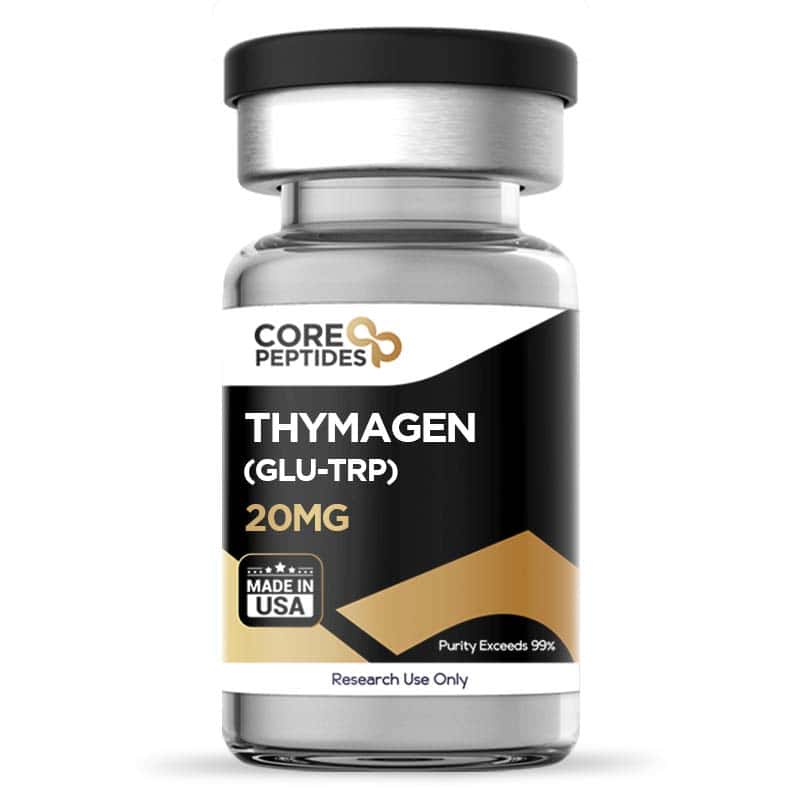
Thymagen is the dipeptide Glu-Trp (EW), a synthetic thymus-peptide analog. Content size is 20mg, in the form of lyophilized powder. Peptides are sold for laboratory research use only.
Tested by: Vanguard Laboratory, see Certificate of Analysis
SKU: P-THYMAGEN-20
Discount per Quantity
| Quantity | Discount | Price |
|---|
| 5 - 8 | 5% | $74.10 | |
| 9 + | 10% | $70.20 |
What Is Thymagen?
Thymagen, also known as EW (Glu-Trp), is a synthetically formulated bioregulator peptide, classified within the group of Khavinson peptides. It is an artificial peptide analog of the thymus-derived polypeptide, thymalin, and is noted for its potential immunomodulating characteristics. Thymagen’s role in immune system modulation is becoming increasingly recognized. It seems to interact with key immune processes, potentially modifying immune responses and defense mechanisms. This includes the possibility of altering immune cell activities and influencing the production of various cytokines. In cellular studies, Thymagen research has suggested its potential action on immune regulation, positing its involvement in reinforcing the natural defense mechanisms.
Specifications
| Name | Thymagen |
| Other known names | Thymogen, Oglufanide, EW (Glu-Trp) |
| Sequence | Glu-Trp (2 amino acids) |
| Molecular formula | C16H19N3O5 |
| Molecular weight | 333.34 g/mol |
| CAS number | 38101-59-6 |
| Synthesis | Solid-phase peptide synthesis, US |
| Form | Lyophilized powder |
| Amount per vial | 20 mg |
| Purity | 98.51% (HPLC) |
| Storage | −20 °C, dry, protected from light |
| SKU | P-THYMAGEN-20 |
What Does Research Show About Thymagen?
How May Thymagen Affect Immune Cells?
Key finding: In lab models infected with Yersinia enterocolitica, Thymagen given from day 2 after infection reduced the polyclonal immune response and autoimmune reactions, enhanced nonspecific resistance and reduced the spread of the bacteria to organs and tissues.(2)
The research on Thymagen may indicate a potential influence on cyclic nucleotide systems in guinea pig models, which is particularly noted in the context of anaphylaxis and sensitization. In such models, Thymagen, along with other peptide substances with similar potential like thymalin and vilosen, possibly affects the catabolic processes of cyclic nucleotides. In sensitized animals, researchers have noted an apparent decrease in the ratio of cyclic adenosine monophosphate (cAMP) to cyclic guanosine monophosphate (cGMP). Thymagen’s potential role in this process appears to be connected to a modulation of this ratio. When anaphylaxis occurs, the cAMP/cGMP ratio apparently returns to a reference level, implying a balancing action. Further, Thymagen may potentially contribute to the increased activity of enzymes responsible for cyclic nucleotide catabolism in lymphocytes of sensitized murine models. This tendency towards an increase is also posited in lymphocytes of guinea pig models of anaphylaxis.(1)
Apart from anaphylaxis and hypersensitivity models, Thymagen has also been researched regarding its potential action in models of bacterial infections. According to one trial, Thymagen may have a potential immunoregulatory action in lab models of Yersinia enterocolitica infection. This potential might include a reduction in the polyclonal immune response and the development of autoimmune reactions. Notably, Thymagen appeared to have promoted the intensive development of delayed hypersensitivity in a model of enteral infection with Yersinia enterocolitica. However, it is important to note that this action did not appear to manifest in all cases. Furthermore, Thymagen appeared to have enhanced the nonspecific resistance of the lab models. This enhancement may have potentially contributed to a decrease in the spread of the infective agents across various organs and tissues and facilitated their subsequent elimination.(2)
Thymagen may also have potential to regulate immunological processes, particularly in the context of T-lymphocyte differentiation and secondary immunodeficiency in experimental models of autoimmune conditions. It is posited that Thymogen may act to modulate certain immune responses, thereby reducing potential secondary immune deficit in these models. The researchers commented that “clinical effect […] was registered in 94.4%, laboratory effect in 83.3%” in tested models.(3)
Other experiments have also investigated scenarios involving secondary immunodeficiency, particularly in models of fungal infections like candidiasis. The underlying hypothesis of one such study posits that Thymogen might possibly activate the immunocompetent system, including the thymus. This activation is thought to potentially contribute to the mitigation of the severity of candidiasis. In murine models, where secondary immunodeficiency is induced and followed by the development of candidiasis, Thymogen has been suggested to affect the course of the infection. The observations suggest that after exposure to Thymogen, the severity of candidiasis in these models might be reduced. This outcome implies that Thymogen may have a role in bolstering the immune response, particularly in fungal infection models.(4)
What Does Research Suggest About the Heart?
Key finding: In an isolated heart model of ischemia and reperfusion, Thymagen had a stronger cardioprotective effect than dalargin and verapamil, acting without the opiate receptors and without blocking calcium entry into heart muscle cells.(5)
Thymagen may have shown potential in addressing various types of arrhythmias in murine models. This potential has been posited through its examination in six distinct arrhythmia models. These models include those apparently induced by agents like aconitine, calcium chloride, strophanthin, scenarios of low sodium levels, reperfusion, and epinephrine administration. These agents are also known to induce ischaemia and therefore used to model arrhythmia. Yet, more trials are needed to evaluate and assess these findings. The scientists specifically noted that “The mechanism of the Thymogen anti-ischemic action is realized without the participation of the opiate receptors and blockade of calcium entrance into the cardiomyocytes.”(5)
What Does Research Suggest About Tumor Development?
Key finding: In male lab models given the carcinogen N-nitrososarcosine ethyl ester for 8 weeks, Thymagen over the following 32 weeks lowered the incidence of esophageal and forestomach tumors by 12% and tumor multiplicity 1.7-fold.(6)
A study in rat models which underwent exposure of N-nitrososarcosine ethyl ester (NSEE) reported an apparent induction of the formation of papilloma cells and carcinoma cells in cultures from the esophagus. The researchers reported that Thymagen apparently decreased the occurrence of such tumor cells by roughly 12% and seemingly reduced the tumor multiplicity by 1.7 times.(6)
In another study involving murine models and Thymagen, the models were exposed to high levels of radiation exposure from radionuclide over 12 months, ultimately inducing the formation of cancer cells. Some of these models were also apparently introduced with Thymagen for five consecutive days each month, alongside the radionuclide exposure. The results from this study suggested that the murine models exposed to radionuclides alone exhibited a higher occurrence of tumor cells generally, and especially in cell lines from breast tissue. Conversely, in the rats that were also exposed to Thymagen alongside the radionuclides, there appeared to be a reduction in both the total number of tumor cells and their incidence. Furthermore, the study posited that murine models exposed only to Thymagen (without radionuclide exposure) appeared to exhibit an apparently longer lifespan, a slower aging rate, and a lower overall occurrence of tumor cells, both malignant and benignant. This finding may highlight Thymagen’s potentially broader role in influencing aging and tumor development, beyond its apparent interaction with radiation-induced carcinogenesis.(7)
A third study explored the potential of Thymagen, particularly focusing on its action on cellular immunity in the context of subjects with solid tumors in the abdominal cavity and retroperitoneal space, specifically before manual excision. Study findings following Thymagen exposure for seven days suggest that it may potentially aid in restoring the structural and functional parameters of cellular immunity, when compared to a placebo group. This potential is indicated by a reduction in the number and severity of complications observed in the study, as well as a possible shortening of the recovery period following an excision.(8)
Certificate of Analysis
| Batch / lot | C74200 |
| Test date | 7/15/2026 |
| Testing laboratory | Vanguard Laboratory |
| Method | HPLC-UV/VIS (identity and purity) |
| Purity result | 98.51% |
| Full report | Download the Thymagen COA (PDF) |
Thymagen peptide is available for research and laboratory purposes only. We offer free shipping in the US for orders over $200. Please review our Terms and Conditions before ordering.
Frequently Asked Questions
What is Thymagen?
Thymagen (Thymogen, Oglufanide) is the synthetic dipeptide Glu-Trp (EW), a Khavinson peptide developed as an analog of the thymus peptide preparation Thymalin.
What has Thymagen been studied for?
Studies in lab models have examined Thymagen in immune responses, bacterial and fungal infections, heart ischemia and tumor development.
What is the molecular weight of Thymagen?
Thymagen has the molecular formula C16H19N3O5 and a molecular weight of approximately 333.34 g/mol.
How should Thymagen be stored?
Lyophilized Thymagen should be stored at −20 °C, dry and protected from light.
Is Thymagen third-party tested?
Yes. The current batch (C74200) was tested by a third-party laboratory and showed 98.51% purity by HPLC. Its certificate of analysis is available on this page.
References:
- Demidov, S. V., Kostromin, A. N., Kuĭbeda, V. V., Chernaia, I. V., & Borovok, M. I. (1991). [Effect of thymagen, thymalin and vilosen on the cAMP and cGMP levels and phosphodiesterase activity in spleen lymphocytes during sensitization and anaphylactic shock]. Ukrainskii biokhimicheskii zhurnal, 63(4), 104–106. https://pubmed.ncbi.nlm.nih.gov/1659006/
- Iushchuk, N. D., Tseneva, G. Ia., Alenushkina, T. V., & Kuliashova, L. B. (1995). [The efficacy of using thymogen in an experimental infection caused by Yersinia enterocolitica]. Zhurnal mikrobiologii, epidemiologii i immunobiologii, (3), 106–108. https://pubmed.ncbi.nlm.nih.gov/7660690/
- Zhuk, E. A., & Galenok, V. A. (1996). [Thymogen in the treatment of type-1 diabetes mellitus]. Terapevticheskii arkhiv, 68(10), 12–14. https://pubmed.ncbi.nlm.nih.gov/9026934/
- Khmel’nitskiĭ, O. K., Iakovlev, G. M., Belianin, V. L., Khavinson, V. Kh., Morozov, V. G., & Deĭgin, V. I. (1990). [The effect of a synthetic thymus peptide (thymogen) on the immune system in candidiasis under immunodepression]. Arkhiv patologii, 52(1), 20–25. https://pubmed.ncbi.nlm.nih.gov/2337388/
- Filippova, O. V., Reznikov, K. M., Alabovskiĭ, V. V., Khamburov, V. V., & Vinokurov, A. A. (1997). [The effect of thymogen on the heart in ischemia and reperfusion]. Eksperimental’naia i klinicheskaia farmakologiia, 60(3), 27–29. https://pubmed.ncbi.nlm.nih.gov/9324392/
- Bespalov, V. G., Troian, D. N., Petrov, A. S., Morozov, V. G., & Khavinson, V. Kh. (1989). [Inhibiting effect of thymogen on the development of tumors of the esophagus and forestomach induced by N-nitrososarcosine ethyl ester in rats]. Eksperimental’naia onkologiia, 11(4), 23–26. https://pubmed.ncbi.nlm.nih.gov/2759010/
- Anisimov, V. N., Miretskiĭ, G. I., Morozov, V. G., Pavel’eva, I. A., & Khavinson, V. Kh. (1992). [The effect of the synthetic immunomodulator thymogen on radiation-induced carcinogenesis in rats]. Voprosy onkologii, 38(4), 451–458. https://pubmed.ncbi.nlm.nih.gov/1300740/
- Smirnov, V. S., Petlenko, S. V., & El’tsin, S. S. (2011). [Application thymogen for preoperative preparation of elderly patients with tumor processes in abdominal cavity]. Advances in gerontology = Uspekhi gerontologii, 24(2), 278–284. https://pubmed.ncbi.nlm.nih.gov/21957588/
Related reading: Thymagen research: immune cell regulation and Thymogen and immune cell regulation.