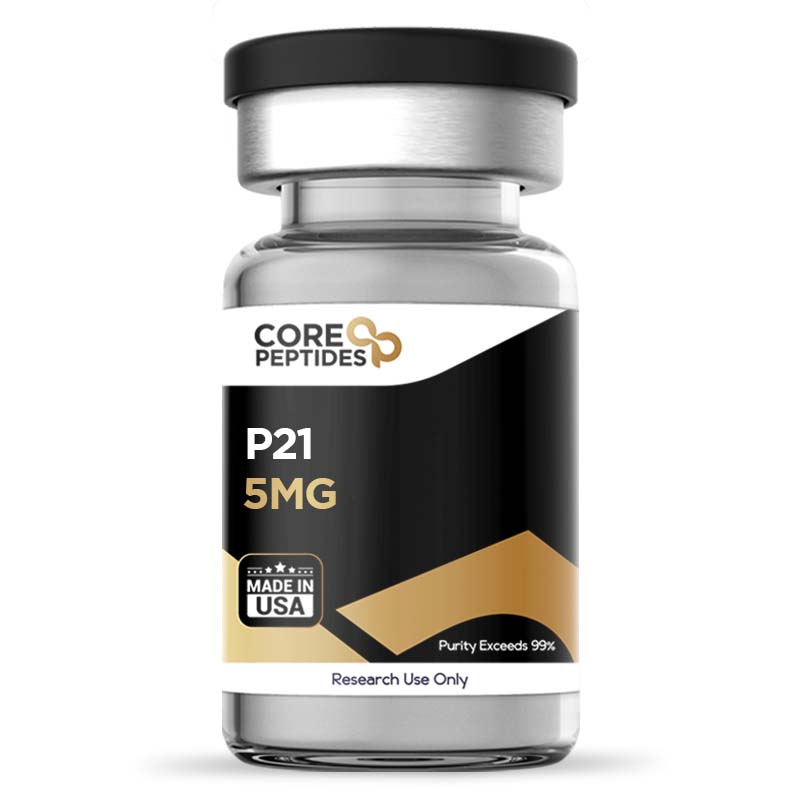
P21 – 5MG
$116.00
P21 (P021) is a synthetic CNTF-derived peptide, Ac-DGGL-adamantylglycine-NH2. Content size is 5mg, in the form of lyophilized powder. Peptides are sold for laboratory research use only.
Tested by: Vanguard Laboratory, see Certificate of Analysis
SKU: P-P21
Discount per Quantity
| Quantity | Discount | Price |
|---|
| 5 - 8 | 5% | $110.20 | |
| 9 + | 10% | $104.40 |
What Is P21?
The P21 (also identified as P021) is a synthetic peptide designed to mimic the activity of ciliary neurotrophic factor (CNTF) on the brain. CNTF is a protein that promotes the survival and differentiation of various neural cells, including neurons and oligodendrocytes. CNTF has been suggested to exhibit possible neuroprotective and neuroregenerative activity in animal models of neurodegenerative diseases and injuries. Scientists identified CNTF’s most active regions based on epitope mapping of neutralizing antibodies to CNTF.(1) This led to the development of Peptide 6, made of 11 amino acids (Ac-VGDGGLFEKKL-NH(2)) and a subsequence of just 4 amino acids called Peptide 6c (Ac-DGGL-NH(2)).
These amino acids have been theorized to support hippocampus-dependent learning and memory, increase neurogenesis, and potentially boost neuronal plasticity, as posited in murine models. To improve the stability of the peptide and boost its potential to pass through the blood-brain barrier, the scientists report that they “added adamantane building blocks to the C-terminus or both C- and N-termini of Peptide 6c.” The result is P21, which appears to have the potential to mimic the action of CNTF by activating the CNTF receptor complex and downstream signaling pathways, possibly leading to enhanced cognition, increased proliferation, and neuronal differentiation of adult hippocampal progenitors in murine models.
Specifications
| Name | P21 |
| Other known names | P021, Peptide 021 |
| Sequence | Ac-Asp-Gly-Gly-Leu-adamantanylglycine-NH2 (Ac-DGGLAG-NH2) |
| Molecular formula | C27H42N6O8 |
| Molecular weight | 578.7 g/mol |
| CAS number | 1246751-68-7 |
| Synthesis | Solid-phase peptide synthesis, US |
| Form | Lyophilized powder |
| Amount per vial | 5 mg |
| Purity | 98.32% (HPLC) |
| Storage | −20 °C, dry, protected from light |
| SKU | P-P21 |
What Does Research Show About P21?
How May P21 Affect Cognitive Impairment?
Key finding: In 3xTg-AD lab models given P21 in the diet from 3 months of age, 6–9 months before amyloid-β or tau pathology, P21 rescued dendritic and synaptic deficits, boosted neurogenesis and reversed cognitive impairment.(2)
P21 has been extensively researched in experimental models of cognitive impairment. One notable study examined the impact of P21 peptide exposure in 3xTg-AD murine models between 6-9 months prior to the onset of amyloid beta (Aβ) or tau pathology and during the period of synaptic compensation.(2) The study suggested that P21 appeared to rescue dendritic and synaptic deficits, boost neurogenesis, and reverse cognitive impairment in the 3xTg-AD murine models. The study suggests that P21 may contribute to the mitigation of synaptic deficits and cognitive impairment by potentially providing neurotrophic support during synaptic compensation. According to the researchers, this potential may be achieved via the proposed influence of the peptide on synaptic plasticity, as the peptide appears to increase the levels of several markers essential for synaptic function, such as synapsin, PSD-95, and MAP2. Synapsin may regulate neurotransmitter release, which is considered crucial for communication between neurons. PSD-95 is posited to organize components within postsynaptic densities, ensuring signals are received and processed at synaptic junctions. MAP2 is thought to stabilize microtubules in dendrites, supporting their structure and possibly influencing the formation and maintenance of synaptic connections. Overall, these proteins may support the regulation of neurotransmitter release, potentially stabilizing synaptic changes and maintaining the structural integrity of dendrites. These are essentially nerve cell projections that may receive information from other neurons, called presynaptic neurons, or from the environment. By boosting these markers, P21 is posited to help preserve and enhance synaptic functionality.
Another study suggested that the P21 may reduce the natural decline in learning and memory in aged Fisher murine models by inhibiting neurogenesis deficit and possibly increasing the expression of brain-derived neurotrophic factor (BDNF) and restoring synaptic deficits in the cortex and hippocampus.(3) BDNF is posited to be a key protein in the survival and differentiation of neurons and the growth of dendrites. BDNF may work by activating pathways that may prevent cell death and promote the differentiation of progenitor cells into mature neurons, especially in the hippocampus, which may aid in ongoing neurogenesis. BDNF is also thought to be instrumental in enhancing synaptic plasticity. It may help strengthen synaptic connections and modulate neurotransmitter release, facilitating better cognition in models of cognitive impairment. BDNF may also contribute to the structural complexity of neurons by encouraging the growth and branching of dendrites, thereby increasing neural connectivity. The study also indicated that P21 appeared to reduce the concentration of myoinositol, a metabolite that naturally increases in murine models. The study suggests that “stimulating endogenous neuroprotective mechanisms using P21 may be [an interesting research] approach for cognitive aging, Alzheimer’s disease, and associated neurodegenerative disorders.”
What Does Research Suggest About P21 in Alzheimer’s Disease (AD) Models?
Key finding: In aged lab models, chronic oral P21 lowered total tau in the brain and reduced the elevated tau in the cerebrospinal fluid to the levels seen in young models, without a detectable immune reaction.(4)
Experiments are actively investigating the potential research outcomes of P21 in Alzheimer’s models. One study focusing on the potential of P21 suggested that chronic exposure of P21 appeared to possibly reduce the brain level of total tau in aged Fisher rats and possibly also reduce tau levels in the cerebrospinal fluid (CSF) to that of young adult rats.(4) The study also observed that “P21 [may be] blood-brain-barrier-permeable and [may] not induce any detectable immune reaction.” The exact mechanism for the apparent reduction of tau protein levels remains unknown. Yet, the researchers posit that the increased BDNF activity may modulate downstream effectors such as glycogen synthase kinase-3 (GSK-3). GSK-3 is posited to be a kinase involved in the phosphorylation of tau. Phosphorylated tau is prone to aggregation, forming neurofibrillary tangles, a hallmark of Alzheimer’s (AD) models. By modulating BDNF levels, P21 may indirectly inhibit GSK-3 activity, potentially reducing tau phosphorylation.
Another study investigated the potential of P21 on neurobehavior and AD-like pathology in a transgenic murine model of AD.(5) The compound was presented during the mice’s prenatal to early postnatal development. Results suggested that the peptide appeared to rescue cognitive deficits, reduce abnormal accumulation of tau and Aβ plaque load, ameliorate certain markers of postsynaptic deficits, and decrease neuroinflammation in the brain. The purported mechanism may have involved improving PSD-95 levels and cAMP response element-binding protein (CREB) activity, which are considered markers of synaptic function and memory formation. Additionally, P21 may have reduced glial fibrillary acidic protein (GFAP) levels, indicating a potential decrease in neuroinflammation.
In another experiment, the researchers investigated the neurotrophic potential of the P21 compound in preventing neurodegeneration, amyloid-β, and tau pathologies in 3xTg-AD murine models.(6) The researchers started P21 exposure during the period of synaptic compensation several months before the appearance of any overt pathology. They observed that P21 initiated during this period might have prevented neurodegeneration, Aβ, and tau pathologies, rescued episodic memory impairment, and may have potentially reduced the mortality rate.
One trial also investigated the potential of P21 on cognitive function and synaptic plasticity in a transgenic murine model of AD.(7) Results indicated that the peptide might mitigate cognitive impairment, increase expressions of pCREB and BDNF, and ameliorate synaptic protein deficit in the murine models. These actions may lead to the activation of three key signaling pathways: PLC/PKC, MEK/ERK, and PI3K/Akt. These pathways are purported to play a potential role in neuronal survival, growth, and synaptic plasticity. By enhancing these signaling cascades, the peptide is posited to improve synaptic protein expression. The study also suggests that P21 might potentially rescue synaptic deficits and cognitive impairment in familial AD and related tauopathies during early development.
Could P21 Affect Models of Macular Degeneration?
Key finding: In aged lab models and 3xTg-AD lab models, chronic P21 (3 and 18 months) ameliorated AMD-like retinal changes, including photoreceptor degeneration, retinal pigment epithelium atrophy and Bruch’s membrane thickening.(8)
Age-related macular degeneration (AMD) affects the macula, the central part of the retina responsible for central vision. It is considered a common neurodegenerative disease that may lead to vision loss at its end stage. Recent research has suggested that consistent exposure to the neurotrophic peptidergic compound may help prevent the occurrence of AMD pathology.
A study conducted in aged and 3xTg-AD murine models reported that chronic presentation of P21 appeared to possibly prevent several pathological changes associated with AMD.(8) The study reported identifying photoreceptor degeneration, lipofuscin granules, vacuoles, atrophy in retinal pigment epithelium (RPE), and Bruch’s membrane (BM) thickening. The study also reported a rosette-like structure formation in aged murine models, a hallmark of AMD pathology. Microgliosis and astrogliosis, inflammatory responses in the retina, were also observed in different retinal layers. Furthermore, the study indicated that total tau, phosphorylated tau, Aβ/APP, and VEGF appeared widely distributed in the sub-retina of aged and 3xTg murine models. These molecules are associated with Alzheimer’s disease pathology, and their presence suggests that retinal changes associated with aging and Alzheimer’s disease may share some common features. Importantly, consistent exposure to P21 for three months in rats and 18 months in 3xTg murine models appeared to ameliorate the pathological changes described above.
Certificate of Analysis
| Batch / lot | C73684 |
| Test date | 7/15/2026 |
| Testing laboratory | Vanguard Laboratory |
| Method | HPLC-UV/VIS (identity and purity) |
| Purity result | 98.32% |
| Full report | Download the P21 COA (PDF) |
P21 peptide is available for research and laboratory purposes only. We offer free shipping in the US for orders over $200. Please review our Terms and Conditions before ordering.
Frequently Asked Questions
What is P21?
P21 (P021) is a synthetic peptide, Ac-DGGLAG-NH2, derived from the most active region of ciliary neurotrophic factor (CNTF), with an adamantane-based amino acid added at the C-terminus to increase blood-brain barrier permeability and resistance to breakdown.
What has P21 been studied for?
Studies in lab models have examined P21 in cognitive aging, in Alzheimer’s disease models (3xTg-AD) and in AMD-like retinal changes, looking at neurogenesis, synaptic markers, tau and amyloid-β.
What is the molecular weight of P21?
P21 has the molecular formula C27H42N6O8 and a molecular weight of approximately 578.7 g/mol.
How should P21 be stored?
Lyophilized P21 should be stored at −20 °C, dry and protected from light.
Is P21 third-party tested?
Yes. The current batch (C73684) was tested by a third-party laboratory and showed 98.32% purity by HPLC. Its certificate of analysis is available on this page.
References:
- Li, B., Wanka, L., Blanchard, J., Liu, F., Chohan, M. O., Iqbal, K., & Grundke-Iqbal, I. (2010). Neurotrophic peptides incorporating adamantane improve learning and memory, promote neurogenesis and synaptic plasticity in mice. FEBS letters, 584(15), 3359–3365. https://doi.org/10.1016/j.febslet.2010.06.025
- Baazaoui, N., & Iqbal, K. (2017). Prevention of dendritic and synaptic deficits and cognitive impairment with a neurotrophic compound. Alzheimer’s research & therapy, 9(1), 45. https://doi.org/10.1186/s13195-017-0273-7
- Bolognin, S., Buffelli, M., Puoliväli, J., & Iqbal, K. (2014). Rescue of cognitive-aging by administration of a neurogenic and/or neurotrophic compound. Neurobiology of aging, 35(9), 2134–2146. https://doi.org/10.1016/j.neurobiolaging.2014.02.017
- Khatoon, S., Chalbot, S., Bolognin, S., Puoliväli, J., & Iqbal, K. (2015). Elevated tau level in aged rat cerebrospinal fluid reduced by treatment with a neurotrophic compound. Journal of Alzheimer’s disease, 47(3), 557–564. https://doi.org/10.3233/JAD-142799
- Wei, W., Wang, Y., Liu, Y., Dai, C. L., Tung, Y. C., Liu, F., & Iqbal, K. (2020). Prenatal to early postnatal neurotrophic treatment prevents Alzheimer-like behavior and pathology in mice. Alzheimer’s research & therapy, 12(1), 102. https://doi.org/10.1186/s13195-020-00666-7
- Baazaoui, N., & Iqbal, K. (2017). Prevention of amyloid-β and tau pathologies, associated neurodegeneration, and cognitive deficit by early treatment with a neurotrophic compound. Journal of Alzheimer’s disease, 58(1), 215–230. https://doi.org/10.3233/JAD-170075
- Wei, W., Liu, Y., Dai, C. L., Baazaoui, N., Tung, Y. C., Liu, F., & Iqbal, K. (2021). Neurotrophic treatment initiated during early postnatal development prevents the Alzheimer-like behavior and synaptic dysfunction. Journal of Alzheimer’s disease, 82(2), 631–646. https://doi.org/10.3233/JAD-201599
- Liu, Y., Wei, W., Baazaoui, N., Liu, F., & Iqbal, K. (2019). Inhibition of AMD-like pathology with a neurotrophic compound in aged rats and 3xTg-AD mice. Frontiers in aging neuroscience, 11, 309. https://doi.org/10.3389/fnagi.2019.00309
Related reading: P21 research in neurological disorders and appetite and P021 neuroprotective and neurotrophic potential.