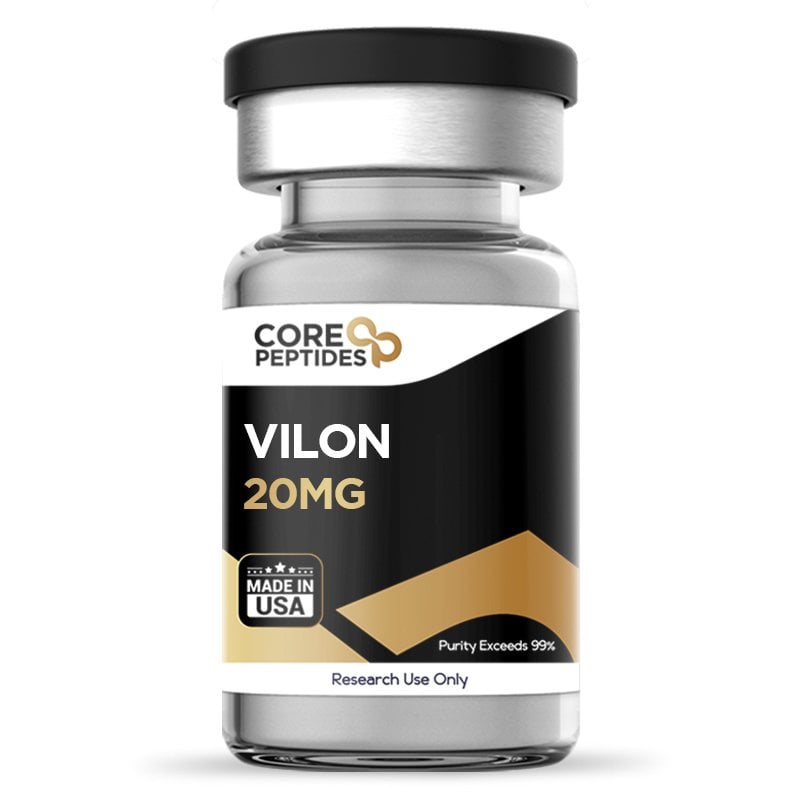
Vilon – 20MG
$74.00
Vilon is the dipeptide Lys-Glu (lysylglutamic acid). Content size is 20mg, in the form of lyophilized powder. Peptides are sold for laboratory research use only.
Purity: 99%+ by HPLC (third-party tested)
Tested by: Vanguard Laboratory, see Certificate of Analysis
SKU: P-Vilon
Discount per Quantity
| Quantity | Discount | Price |
|---|
| 5 - 8 | 5% | $70.30 | |
| 9 + | 10% | $66.60 |
What Is Vilon?
Vilon is a dipeptide composed of amino acids lysine and glutamic acid. It also goes by the name ‘Lysylglutamic Acid or Lysylglutamate.’(1) It is the shortest peptide suggested to possess potential action in the immune system, possibly mitigate cancer cell proliferation, and potentially induce anti-aging action within cells, possibly working on tissues within the liver, heart, and kidney. Vilon appears to exert its potential by possible interaction with the chromatin structure.
Vilon peptide research has also led to the postulating of several research hypotheses, including that the peptide may act to unroll chromatin structures, that it may activate ribosomal genes stimulating the synthetic process, that it may release inactive genes, and that it may not decondense the chromatin situated on each side of the centromere of the chromosome. Through its potential action on the chromatin, Vilon may possibly alter DNA structure to reactivate the genes and cells that have gone ‘silent.’(2)
How Is Vilon Thought to Work?
Considered a bioregulator peptide, researchers speculate that Vilon may potentially support functions within the immune system, including in immunocompromised animal models. Researchers suggest Vilon may activate the interleukin-2 protein in spleen cells, which is considered critical in maintaining immune function.(3) It may stimulate the organism to fight against microbial infection and foreign bodies and prevent harmful autoimmune responses. Vilon has been suggested to activate white blood and spleen cells and potentially naturally boost the organism to protect against autoimmune elements.
A study was conducted in 2002 with three bioregulatory peptides to study their potential on interleukin-2 mRNA synthesis in spleen cells. According to this study, “The intensity of interleukin-2 mRNA synthesis in splenocytes depended on the type, concentration, and duration of [exposure] with the peptides. Vilon and Epithalon were most potent, while Cortagen produced a less pronounced effect on interleukin-2 mRNA synthesis.”(3)
Furthermore, research suggests that Vilon peptides may possibly mitigate autoimmune action by interacting with the thymus gland. The thymus gland is considered responsible for the proliferation of T-helper cells, and with the help of the Vilon peptide, this proliferation may be further enhanced. As per Sevostianova et al., the Vilon peptide is “considered as a bioactive substance possessing immunomodulator and antiallergic activity.” (4) The research indicates that there is a potential for Vilon to enhance the expression of the CD5 molecule in embryonic thymic cells. Specifically, the data revealed a tentative increase of 78% in the expression levels of CD5 in rat thymic cells and a 45% increase in embryonic thymic cells compared with the baseline levels in the control group. CD5 is a marker important in the development and maturation of T-cells in the thymus, an organ considered pivotal for the generation of immune cells. The study further hypothesizes that Vilon may influence the maturation process of thymic cells, potentially steering the development of T-cell precursors more toward becoming CD4+ T-helper cells. T-helper cells are deemed critical components of the adaptive immune system, aiding in the activation and direction of other immune cells.
Specifications
| Name | Vilon |
| Other known names | Lys-Glu, lysylglutamic acid, Normophthal, KE dipeptide |
| Sequence | Lys-Glu (2 amino acids) |
| Molecular formula | C11H21N3O5 |
| Molecular weight | 275.30 g/mol |
| CAS number | 45234-02-4 |
| Synthesis | Solid-phase peptide synthesis, US |
| Form | Lyophilized powder |
| Amount per vial | 20 mg |
| Purity | >99% (HPLC) |
| Storage | −20 °C, dry, protected from light |
| SKU | P-Vilon |
What Does Research Show About Vilon?
Extended research has produced a wide variety of hypotheses speculating on the action of the Vilon peptide, some detailed below:
How May Vilon Affect Lifespan?
Key finding: In female lab models exposed to Vilon from the 6th month of life, physical activity and endurance increased, body temperature decreased, lifespan was prolonged and fewer spontaneous tumors developed, with no unfavorable effects on development.(5)
Vilon may potentially extend the average lifespan of certain animal models under laboratory conditions through an extension and mitigation of cell death. As stated above, Vilon has been suggested to exhibit potential in enhancing the immune system, improving physical endurance and energy levels, thereby possibly increasing average lifespan of animal test models.(5) Vilon is advised to study earlier in the test model lifespan rather than later for clearest possible action. Researchers hypothesize when a bioregulator like Vilon is exposed in vivo in lab models, it may only reverse ‘silent’ cells, exerting no apparent action on cells killed via apoptosis.
In another experiment, researchers explored the potential of Vilon on spleen organotypic tissue cultures derived from murine models of differing ages. The findings from this investigation suggest that Vilon potentially influences the development of the explants.(6) Further research investigated research models where the peptide was introduced into the cultural medium of tissue explants derived from murine models at varying stages of development: 3 days, 3 weeks, and 2 years old. It was posited that Vilon induces morphological stability in the tissues while potentially activating both regeneration and functional activity of the cells involved. Interestingly, the results suggest that the impact of Vilon appeared to be more pronounced in explants from older murine models. This observation leads to the hypothesis that Vilon may have potential relevance in geriatric research, focusing on the mechanisms of cell aging and regeneration. The possibility that Vilon preferentially supports older tissues might be indicative of its role in modulating age-related cellular mechanisms or promoting stability in more senescent cells.(7)
Another study examined the actions of low amounts of ionizing radiation, which apparently leads to accelerated cell aging of the thymus and spleen in murine models. Vilon was tested for its potential to mitigate this accelerated cellular aging process. The researchers tentatively suggest that Vilon partially inhibited the pro-aging action induced by the radiation. This research posits that Vilon might be of interest in the field of geriatric research, potentially as an agent to manage or reduce the impacts of cell aging in critical immune organs post-radiation exposure. The study highlights Vilon’s potential role in preserving organ function in an irradiated environment, which may be crucial for developing strategies against radiation-induced degeneration in murine models.(8)
What Does Research Suggest About Tumor Development?
Key finding: Vilon lowered the incidence of urinary bladder tumors induced by N-butyl-N-(4-hydroxybutyl)nitrosamine in lab models to 56%, compared with 75.5% in controls, and halved the incidence of preneoplastic and early neoplastic changes in the bladder mucosa.(10)
Several studies suggest that peptide exhibits the potential to prevent some spread of carcinogenic cells by preventing the formation of new tumors, and potentially inhibiting existing tumors’ growth.(9) Another study examined the potential of Vilon on the development of urinary bladder carcinogenesis in murine models exposed to N-butyl-N-(4-hydroxybutyl)nitrosamine (BBNA).(10) The experiment included a control group and a Vilon-exposed group. Each group began with 50 rats, all of which received BBNA. The primary observation was that the incidence of urinary bladder cancer cells was lower in the Vilon-exposed group compared to the control group. Specifically, cancer cells developed in 56% of the Vilon-exposed murine models versus 75.5% of the controls. This data possibly indicates that Vilon may have a moderating action on cancer cell development when exposed to BBNA. Further, the study noted a reduction in both the prevalence and severity of preneoplastic and early neoplastic changes in the urinary bladder mucosa in the Vilon-exposed murine models. In terms of morphological changes, the study reported fewer hyperplastic changes and lower malignancy rates in the Vilon group. There was a noticeable delay in the malignization of epithelial tissues in the Vilon group, suggesting a potential role of Vilon in modulating the rate or extent of tumor malignancy. Additionally, the average number of tumors per animal was lower in the Vilon group (1.5 tumors per rat) compared to the control group (2.6 tumors per rat), and the tumor cells in the Vilon-exposed rats appeared to manifest with a less aggressive growth pattern. The reduction in tumor aggressiveness and prevalence might indicate that Vilon has the potential to modulate the carcinogenic actions of BBNA. The findings suggest that Vilon, potentially acting as an immunomodulator, might inhibit the early stages of carcinogenesis as well as tumor progression in experimental models.
One study contradicts this potential property of Vilon. According to this study, when used with cyclophosphamide, this peptide–platinum combination may be more harmful than helpful.(11) Unfortunately, since this study only considers one specific type of chemotherapeutic action, the results reported by researchers may be inconclusive.
How May Vilon Affect the Small Intestine?
Key finding: In aged lab models, one month of oral Vilon raised maltase and alkaline phosphatase activity in the epithelial layer of the small intestine and glycyl-L-leucine dipeptidase activity in its stromal and seromuscular layers, which the authors linked to better trophic and barrier functions.(12)
Vilon peptide may act on gastrointestinal functionality by possibly enhancing the working mechanisms of certain enzymes in the gastrointestinal tract. By doing so, the peptide exhibits potential resistance towards GI-specific ailments, and may reduce leaky bowels in animal models.(12) Acting on the small intestinal muscles, Vilon peptide may ameliorate glucose accumulation and glycine absorption.(13)
What Does Research Suggest About Gene Expression?
Key finding: In heart tissue of lab models, Vilon changed the expression of 36 of 15,247 cDNA clones more than 2-fold, Epithalon changed 98 and the two together changed 144.(14)
Upon presenting the Vilon peptide, researchers have suggested it exhibits potential to alter the gene expression of 36 genes in the heart. When presented with Epitalon, this number was reported as 144 genes. This suggests the peptide’s possible action on genetic expression in the cardiac system, possibly impacting hemodynamic actions.(14)
What Does Research Suggest About Fibrinolysis and Microvessels?
Key finding: In lab models with chronic renal failure, Vilon lowered serum transforming growth factor-beta1 and the permeability of mesenteric microvessels 2 months after onset.(16)
Researchers suggested in one study that Vilon exhibits the potential to stimulate fibrinolysis and increase the concentration of natural anticoagulants in the organism, namely antithrombin III and protein C. It was also suggested to reduce insulin levels and possibly regulate the metabolism of carbohydrates.(15) This suggests a possible interplay between Vilon’s actions on coagulation and glucose regulation, although the mechanisms behind this interaction are not fully elucidated in the study. Furthermore, the study posits that Vilon may have a stabilizing impact on the immune system. This is inferred from changes in various immune cell types and immunoglobulins; notably, a reduction in T-helpers, T-dependent and non-T-dependent NK cells, and a normalization in the levels of active T-lymphocytes, B-lymphocytes, and IgA. Such findings suggest that Vilon may modulate both innate and adaptive immune responses, which may be crucial for overall immune homeostasis.
Further, Vilon is suggested to decrease the permeability of mesenteric microvessels in the vascular system. As per N. Gavrisheva et al., these results indicate that “the preparation produces a potent homeostatic effect in the early period of chronic renal failure.”(16)
Certificate of Analysis
| Batch / lot | C74188 |
| Test date | 7/15/2026 |
| Testing laboratory | Vanguard Laboratory |
| Method | HPLC-UV/VIS (identity and purity) |
| Purity result | 99.03% |
| Full report | Download the Vilon COA (PDF) |
Vilon peptide is available for research and laboratory purposes only. We offer free shipping in the US for orders over $200. Please review our Terms and Conditions before ordering.
Frequently Asked Questions
What is Vilon?
Vilon is the synthetic dipeptide Lys-Glu (lysylglutamic acid), one of the short peptide bioregulators developed by Khavinson and colleagues.
What has Vilon been studied for?
Studies in lab models and cell cultures have examined Vilon in chromatin activity, immune cell function, lifespan, tumor development, small intestine enzymes, gene expression and microvessel permeability.
What is the molecular weight of Vilon?
Vilon has the molecular formula C11H21N3O5 and a molecular weight of approximately 275.30 g/mol.
How should Vilon be stored?
Lyophilized Vilon should be stored at −20 °C, dry and protected from light.
Is Vilon third-party tested?
Yes. The current batch (C74188) was tested by a third-party laboratory and showed >99% purity by HPLC. Its certificate of analysis is available on this page.
References:
- National Center for Biotechnology Information (2026). PubChem Compound Summary for CID 7010502, Lysylglutamic acid. PubChem. https://pubchem.ncbi.nlm.nih.gov/compound/Lysylglutamic-acid
- Lezhava, T., Khavinson, V., Monaselidze, J., Jokhadze, T., Dvalishvili, N., Bablishvili, N., & Barbakadze, S. (2004). Bioregulator Vilon-induced reactivation of chromatin in cultured lymphocytes from old people. Biogerontology, 5(2), 73–79. https://doi.org/10.1023/B:BGEN.0000025070.90330.7f
- Kazakova, T. B., Barabanova, S. V., Khavinson, V. K., Glushikhina, M. S., Parkhomenko, E. P., Malinin, V. V., & Korneva, E. A. (2002). In vitro effect of short peptides on expression of interleukin-2 gene in splenocytes. Bulletin of experimental biology and medicine, 133(6), 614–616. https://doi.org/10.1023/a:1020210615148
- Sevostianova, N. N., Linkova, N. S., Polyakova, V. O., Chervyakova, N. A., Kostylev, A. V., Durnova, A. O., Kvetnoy, I. M., Abdulragimov, R. I., & Khavinson, V. K. (2013). Immunomodulating effects of Vilon and its analogue in the culture of human and animal thymus cells. Bulletin of experimental biology and medicine, 154(4), 562–565. https://doi.org/10.1007/s10517-013-2000-0
- Khavinson, V. K., Anisimov, V. N., Zavarzina, N. Y., Zabezhinskii, M. A., Zimina, O. A., Popovich, I. G., Shtylik, A. V., Malinin, V. V., & Morozov, V. G. (2000). Effect of vilon on biological age and lifespan in mice. Bulletin of experimental biology and medicine, 130(7), 687–690. https://doi.org/10.1007/BF02682106
- Bykov, N. M., & Chalisova, N. I. (2002). [Characteristics of effect of ultralow doses of vilon in organotypic culture of spleens from rats of various ages]. Advances in gerontology, 10, 85–87. https://pubmed.ncbi.nlm.nih.gov/12577696/
- Kniaz’kin, I. V., Iuzhakov, V. V., Chalisova, N. I., & Grigor’ev, E. I. (2002). [Functional morphology of organotypic culture of spleens from rats of various ages exposed to vilon]. Advances in gerontology, 9, 110–115. https://pubmed.ncbi.nlm.nih.gov/12096432/
- Kniaz’kin, I. V., & Poliakova, V. O. (2002). [The effect of vilon on the thymus and spleen in a radiation model of premature aging]. Advances in gerontology, 9, 105–109. https://pubmed.ncbi.nlm.nih.gov/12096431/
- Khavinson, V. K., & Anisimov, V. N. (2000). A synthetic dipeptide vilon (L-Lys-L-Glu) inhibits growth of spontaneous tumors and increases life span of mice. Doklady biological sciences, 372, 261–263. https://pubmed.ncbi.nlm.nih.gov/10944717/
- Pliss, G. B., Mel’nikov, A. S., Malinin, V. V., & Khavinson, V. K. (2001). Inhibitory effect of peptide vilon on the development of induced rat urinary bladder tumors in rats. Bulletin of experimental biology and medicine, 131(6), 558–560. https://doi.org/10.1023/a:1012354603132
- Barykina, O. P., Iuzhakov, V. V., Chalisova, N. I., Kvetnoĭ, I. M., & Konovalov, S. S. (2003). [Combined effect of vilon and cyclophosphane on tumor transplants and lymphoid tissue explants in mice and rats of various age]. Advances in gerontology, 12, 128–131. https://pubmed.ncbi.nlm.nih.gov/14743610/
- Khavinson, V. K., Timofeeva, N. M., Malinin, V. V., Gordova, L. A., & Nikitina, A. A. (2002). Effect of vilon and epithalon on activity of enzymes in epithelial and subepithelial layers in small intestine of old rats. Bulletin of experimental biology and medicine, 134(6), 562–564. https://doi.org/10.1023/a:1022913228900
- Khavinson, V. K., Egorova, V. V., Timofeeva, N. M., Malinin, V. V., Gordova, L. A., & Gromova, L. V. (2002). Effect of Vilon and Epithalon on glucose and glycine absorption in various regions of small intestine in aged rats. Bulletin of experimental biology and medicine, 133(5), 494–496. https://doi.org/10.1023/a:1019878224754
- Anisimov, S. V., Bokheler, K. R., Khavinson, V. K., & Anisimov, V. N. (2002). Studies of the effects of Vilon and Epithalon on gene expression in mouse heart using DNA-microarray technology. Bulletin of experimental biology and medicine, 133(3), 293–299. https://doi.org/10.1023/a:1015859322630
- Kuznik, B. I., Isakova, N. V., Kliuchereva, N. N., Maleeva, N. V., & Pinelis, I. S. (2007). [Effect of vilon on the immunity status and coagulation hemostasis in patients of different age with diabetes mellitus]. Advances in gerontology, 20(2), 106–115. https://pubmed.ncbi.nlm.nih.gov/18306698/
- Gavrisheva, N. A., Malinin, V. V., Ses, T. P., Kozlov, K. L., Panchenko, A. V., & Titkov, A. Y. (2005). Effect of peptide Vilon on the content of transforming growth factor-beta and permeability of microvessels during experimental chronic renal failure. Bulletin of experimental biology and medicine, 139(1), 24–26. https://doi.org/10.1007/s10517-005-0202-9
Related reading: Vilon and immune cell research.