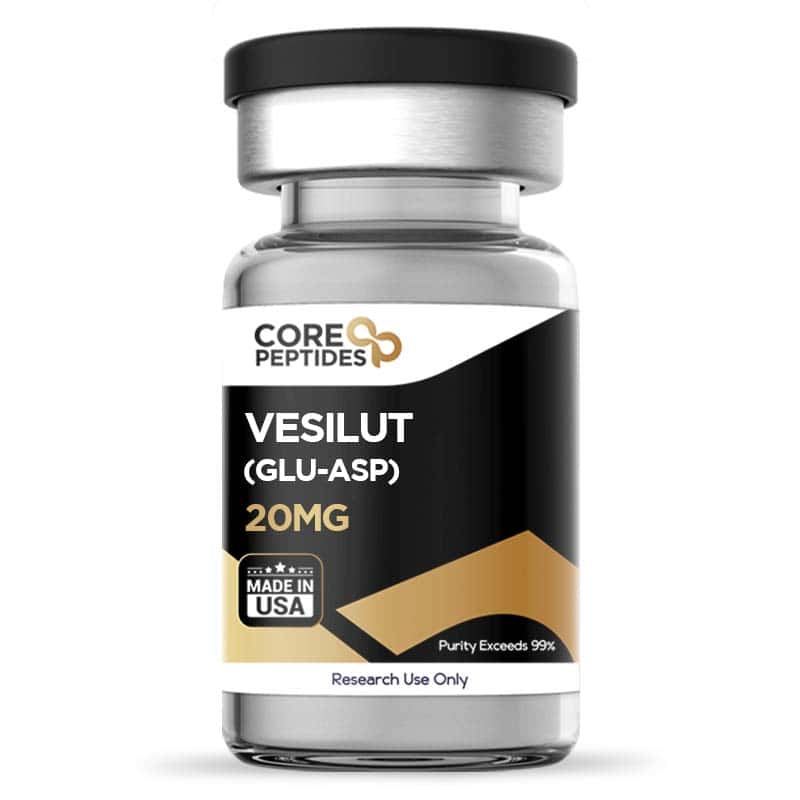
Vesilut – 20MG
$64.00
Vesilut (ED) is the Khavinson dipeptide Glu-Asp. Content size is 20mg, in the form of lyophilized powder. Peptides are sold for laboratory research use only.
SKU: P-VESILUT-20
Discount per Quantity
| Quantity | Discount | Price |
|---|
| 5 - 8 | 5% | $60.80 | |
| 9 + | 10% | $57.60 |
What Is Vesilut?
Vesilut, aka ED (Glu-Asp) is a synthetic bioregulator peptide, classified amongst the Khavinson peptides. It contains the Glu-Asp sequence which is also found in another Khavinson peptide called Prostamax (Lys-Glu-Asp-Pro). There is a general lack of research on Vesilut, but due to its similarity with Prostamax, it is expected to exhibit similar potential action on tissues such as prostate gland cells and bladder cells. As a bioregulator, aka citomedine, Vesilut is posited to exert these actions via direct interaction with the expression of genes on a cellular level.
Specifications
| Name | Vesilut |
| Other known names | ED, Glu-Asp, alpha-glutamylaspartic acid, Vesilute |
| Sequence | Glu-Asp (2 amino acids) |
| Molecular formula | C9H14N2O7 |
| Molecular weight | 262.22 g/mol |
| CAS number | 3918-84-1 |
| Synthesis | Solid-phase peptide synthesis, US |
| Form | Lyophilized powder |
| Amount per vial | 20 mg |
| Storage | −20 °C, dry, protected from light |
| SKU | P-VESILUT-20 |
What Does Research Show About Vesilut?
Due to the lack of any published research that addresses Vesilut’s research potential, we have extracted and presented data from related bioregulators that share the same Glu-Asp sequence.
What Do Related Peptides Suggest About Bladder Function?
Key finding: In male lab models with experimental chronic aseptic prostatitis, Prostamax (Lys-Glu-Asp-Pro, which contains the Glu-Asp sequence of Vesilut) reduced swelling, vascular hyperemia and lymphoid infiltration of the prostate and prevented sclerotic and atrophic changes.(1)
Urinary bladder function is tightly related to that of surrounding tissues and especially the prostate gland tissues. Swelling of prostate tissues may significantly impede the function of urinary bladder tissues. In the realm of bioregulatory peptides, citomedines with a sequence akin to Vesilut (Glu-Asp), have been suggested to induce intriguing mechanisms of action. This is particularly noted within the context of experimental models of chronic aseptic inflammation in prostate tissues, which commonly translates to swelling and impeded urinary bladder tissue function.(1) Thus, researchers have posited that Vesilut’s mechanism may potentially be similar to that of related bioregulators, and may center on modulating key signs of chronic inflammation at the cellular level.
One primary action observed in the trials was the reduction in swelling in the experimental prostate tissues.(1) This appeared to have been achieved by influencing the fluid dynamics and cellular responses in the inflamed tissue, leading to a decrease in edema or swelling. Another potential aspect of Vesilut’s mechanism, based on the data from related bioregulators, is the attenuation of hyperemia, which refers to an excess of blood in the vessels supplying the prostate gland tissues. This regulation of blood flow may be linked to bioregulator influence on the vascular endothelium and smooth muscle cells, leading to a normalization of blood supply and thus reducing the hyperemic state. Furthermore, bioregulators related to Vesilut appear to exert a potential role in modulating cellular infiltration, an indicator of immune response and inflammation. By potentially regulating the migration and activity of immune cells, these citomedines may potentially support a balance in the inflammatory response, preventing excessive cellular infiltration. A crucial aspect of the aforementioned peptides related to Vesilut is their potential to block the development of sclerotic processes. Sclerosis, the hardening of tissues, is considered to often result from prolonged inflammation, and may lead to the thickening and stiffening of the affected tissue. Thickening and stiffening of prostate tissues may also significantly impact the normal functionality of urinary bladder tissues. Citomedines may intervene in the pathways that lead to the accumulation of fibrous tissues, thereby mitigating the progression of chronic inflammation towards sclerosis. Ultimately, the authors concluded that the exposure of related bioregulator peptides apparently led to “reduced swelling intensity, hyperaemia, and cellular infiltration, blocked the development of sclerosal processes.” (1)
How May Vesilut-Related Peptides Affect Gene Activity?
Key finding: In cells from donors aged 75–86, Prostamax (Lys-Glu-Asp-Pro) doubled the frequency of sister chromatid exchanges (12.0 vs 5.9 per cell), raised Ag-positive nucleolus organizer regions (2.5 vs 0.95 per cell) and reduced large pericentromeric heterochromatin segments of chromosomes 1 and 9.(3)
The aforementioned potential actions of Vesilut may be related to its hypothetical action on gene expression in tissues. Related peptides that contain the Glu-Asp sequence have been posited to interact with chromosomes and chromatin, possibly leading to the release of genes previously repressed by heterochromatinization.
Chromatin is a complex of DNA and proteins found in the nucleus of eukaryotic cells. Its primary function is to package DNA into a smaller volume to fit in the cell, control gene expression, and facilitate DNA replication. Chromosomes are long, thread-like structures made of protein and a single molecule of DNA. They carry genetic information in the form of genes. Ribosomal RNA (rRNA), a key component of ribosomes (the cell’s protein factories), is considered to be crucial for translating this genetic code into proteins. The mechanism of peptides with homology to Vesilut may involve alterations in chromatin structure, specifically in aging cells.(2) This alteration might lead to the decondensation of chromatin, as opposed to condensed chromatin which is generally considered to have lower levels of gene activity. By potentially causing decondensation, bioregulator peptides might reactivate certain genes that have been silenced over time due to the natural cell aging process. This reactivation might, in theory, lead to increased protein synthesis and potentially counteract some aspects of cellular aging in various tissues, including prostate gland cells and urinary bladder cells. Thus, the authors posited that “short peptides activate heterochromatin and heterochromatinized regions of cell chromosomes in senile subjects.”
Furthermore, bioregulator peptides similar to Vesilut might influence the dynamics of chromosomes by increasing the frequency of sister chromatid exchanges (SCE).(3) SCEs are a natural process where identical sister chromatids exchange genetic material during cell division. An increase in SCE frequency may suggest a role for Vesilut in enhancing chromosomal repair and maintenance mechanisms, potentially contributing to genomic stability in aging cells. Additionally, bioregulator peptides could potentially impact the activity of ribosomal RNA genes, as suggested by an increase in Ag-positive nucleolus organizer regions (NORs). NORs are chromosomal regions that are involved in the formation of ribosomes. An increase in Ag-positive NORs might indicate enhanced production of rRNA, leading to more ribosomes and thus higher protein synthesis capacity. This change may be particularly significant in aging cells, where protein synthesis often decreases. Lastly, the apparent action of bioregulators like Vesilut might involve the reduction of large segments of C-pericentromeric heterochromatin, particularly in specific chromosomes. Heterochromatin is a tightly packed form of DNA, and its decondensation may imply a release of genes previously repressed by such compact structures, leading to potential changes in gene expression profiles in aging cells.
Vesilut peptide is available for research and laboratory purposes only. We offer free shipping in the US for orders over $200. Please review our Terms and Conditions before ordering.
Frequently Asked Questions
What is Vesilut?
Vesilut (ED) is the synthetic dipeptide Glu-Asp (L-alpha-glutamyl-L-aspartic acid), one of the short peptide bioregulators developed by Khavinson and colleagues.
Has Vesilut itself been studied?
Published research on Vesilut itself is lacking. The studies summarized on this page used related peptides that contain the Glu-Asp sequence, such as Prostamax (Lys-Glu-Asp-Pro).
What is the molecular weight of Vesilut?
Vesilut has the molecular formula C9H14N2O7 and a molecular weight of approximately 262.22 g/mol.
How should Vesilut be stored?
Lyophilized Vesilut should be stored at −20 °C, dry and protected from light.
How is Vesilut related to Prostamax?
Prostamax is the tetrapeptide Lys-Glu-Asp-Pro, which contains the Glu-Asp sequence of Vesilut. Because of this overlap, researchers expect similar actions, but this has not been tested directly.
References:
- Borovskaya, T. G., Pakhomova, A. V., Vychuzhanina, A. V., Poluektova, M. E., Fomina, T. I., Ermolaeva, L. A., et al. (2013). Experimental studying of the drug efficiency Prostamax in the therapy of chronic aseptic prostatitis and its complications. Modern research in inflammation, 2(3). https://doi.org/10.4236/mri.2013.23007
- Khavinson, V. Kh., Lezhava, T. A., & Malinin, V. V. (2004). Effects of short peptides on lymphocyte chromatin in senile subjects. Bulletin of experimental biology and medicine, 137(1), 78–81. https://doi.org/10.1023/b:bebm.0000024393.40560.05
- Dzhokhadze, T. A., Buadze, T. Zh., Gaĭozishvili, M. N., Baratashvili, N. A., & Lezhava, T. A. (2012). [Deheterochromatinization of the chromatin in old age induced by oligopeptide bioregulator (Lys-Glu-Asp-Pro)]. Georgian medical news, (212), 76–82. https://pubmed.ncbi.nlm.nih.gov/23221144/
Related reading: Vesilut research: gene expression and cellular aging and Epigenetic potential of Vesilut.