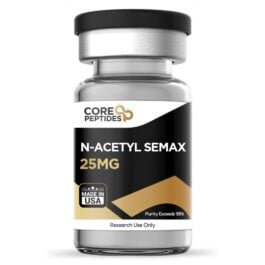
N-Acetyl Selank – 10MG
$71.00
N-Acetyl Selank is the N-acetylated form of Selank, a heptapeptide analog of tuftsin. Content size is 10mg, in the form of lyophilized powder. Peptides are sold for laboratory research use only.
Purity: 99%+ by HPLC (third-party tested)
Tested by: Vanguard Laboratory, see Certificate of Analysis
SKU: N-Acetyl-Selank
Discount per Quantity
| Quantity | Discount | Price |
|---|
| 5 - 8 | 5% | $67.45 | |
| 9 + | 10% | $63.90 |
What Is N-Acetyl Selank?
N-Acetyl Selank is a short, synthetic heptapeptide analogous to the naturally occurring peptide called Tuftsin.(1) Tuftsin is an endogenous tetrapeptide that appears to regulate the immune system. Selank peptide may exhibit immunomodulatory potential; however, it has also been studied in models of anxiety and cognitive decline for its nootropic potential. Apart from the homology with tuftsin, the peptide appears to have a Pro-Gly-Pro fragment at its C-terminus, which may provide an enhancement of Selank’s potential to traverse through different tissues and models including the blood-brain barrier (BBB). The BBB is a highly selective, semi-permeable border that separates the circulating blood from the tissues and extracellular fluid in the central nervous system, and is considered to play a crucial role in regulating the passage of substances. Pro-Gly-Pro addition might enhance BBB permeability by potentially impacting the peptide’s overall hydrophilicity or lipophilicity, thereby increasing its affinity for the lipid-rich environment of the BBB. Additionally, the Pro-Gly-Pro sequence may interact with specific transport mechanisms or receptors at the BBB, potentially triggering a facilitated transport or receptor-mediated endocytosis. Such processes might allow Selank to bypass the tight junctions that normally restrict the passage of large molecules. Pro-Gly-Pro fragment may also influence the peptide’s tertiary structure in a way that makes it more conducive to crossing the BBB.
Further, N-Acetyl Selank Amidate has an additional acetyl group attached to the N-terminus. Adding an acetyl group to the N-terminus in N-Acetyl Selank Amidate may improve the peptide’s stability through several speculative mechanisms. Acetylation might potentially shield the peptide from rapid enzymatic degradation by exopeptidases, as it might make the N-terminus less accessible or recognizable to these enzymes. Additionally, acetylation may induce changes in the peptide’s structure, possibly leading to a more stable conformation that resists denaturation.
How Is N-Acetyl Selank Thought to Work?
Studies suggest that the Selank peptide produces possible action in several ways:
- Firstly, by potentially stimulating the gamma-aminobutyric acid (GABA) receptors system.(2) GABA is considered an inhibitory neurotransmitter in the brain, reducing neuronal excitability, promoting relaxation, and alleviating anxiety. Researchers have posited Selank to potentiate the capacity to induce changes in the expression of genes associated with GABA receptors, transporters, and ion channels. This implies that Selank might potentially influence GABAergic neurotransmission by modulating the availability or functionality of these key components. Furthermore, studies posit that Selank’s actions may potentially extend beyond direct actions on GABA receptor gene expression to allosteric modulation of the GABAergic system. This is hinted at by the differential gene expression patterns observed following Selank and GABA exposure, wherein Selank appeared to have uniquely influenced the expression of certain genes. This nuanced action suggests that Selank may modulate the GABAergic system’s function in a manner distinct from the straightforward receptor activation induced by GABA. Selank might also initiate longer-lasting alterations in neurotransmitter systems, potentially explaining its prolonged anxiolytic actions in experimental models.
- Secondly, the peptide may potentially interact with serotonin signaling.(3) Serotonin signaling in the brain is posited to regulate mood and anxiety. Experiments in murine models with blocked serotonin synthesis suggest that Selank may exert the potential to modulate serotonin levels under compromised serotonergic function. Selank was posited to enhance serotonin metabolism in the brainstem via a rapid onset of action on the serotonin system. Specifically, the peptide was suggested to promote increased metabolic activity of serotonin in parts of the brain linked to regulating mood and anxiety. Further, the study posits that Selank’s potential to elevate serotonin metabolism indicates a possible mechanism through which Selank might correct disturbances associated with reduced serotonin function.
- Thirdly, the peptide may act by potentially modulating enkephalin signaling.(4)(5) Studies have posited that Selank may have an inhibitory action on enkephalin-degrading enzymes. This indicates that Selank might slow down the degradation of enkephalins. Enkephalins, as natural ligands of opioid receptors, are considered to play a role in pain perception and modulating mood and stress, implying that Selank’s action on these enzymes might enhance the availability of enkephalins, thereby potentially amplifying their actions. Studies also posit that there may be a tau(1/2) leu-enkephalin increase during Selank exposure in anxiety models.
- Finally, the peptide may potentially affect brain-derived neurotrophic factor (BDNF) expression.(6) Selank has been suggested to significantly elevate BDNF mRNA levels in the hippocampus, a part of the central nervous system. Selank’s potential to enhance BDNF expression, especially in the context of stress and glucocorticoid-induced suppression of BDNF, points towards its potential research implications for ameliorating reduced neuroplasticity.
- Furthermore, researchers are currently investigating the potential actions of the peptide via genome expression and involvement in the inflammatory process.(7)
Specifications(8)
| Name | N-Acetyl Selank Amidate |
| Sequence | Ac-Thr-Lys-Pro-Arg-Pro-Gly-Pro (7 amino acids; N-terminal acetyl) |
| Molecular formula | C35H59N11O10 |
| Molecular weight | 793.9 g/mol |
| Synthesis | Solid-phase peptide synthesis, US |
| Form | Lyophilized powder |
| Amount per vial | 10 mg |
| Purity | >99% (HPLC) |
| Storage | −20 °C, dry, protected from light |
| SKU | N-Acetyl-Selank |
What Does Research Show About N-Acetyl Selank?
Unfortunately, research on N-Acetyl Selank in its acetylated form is still sparse. However, the peptide is expected to have similar impacts as its unacetylated counterpart, Selank, with the addition possibly only affecting the peptide by providing higher stability. Because of this lack of research data, we cite only Selank studies below.
What Does Research Suggest About Anxiolytic Action?
In 2008, a clinical study(5) was conducted on research models of generalized anxiety disorder (GAD). The research models were divided into two groups – half were presented with allopathic anxiety compounds, and the other half were presented with Selank peptide. After completing this study, the psychometric levels of all models were examined.
Based on the results, it was suggested that the Selank peptide appeared to be potentially as impactful as the control compound in reducing the models’ anxiety levels. The peptide-exposed group also exhibited reportedly positive psychostimulant reactions. As per A A Zozulia et al., “The clinical-biological study revealed that [models] with GAD and neurasthenia had the decreased level of tau(1/2) leu-enkephalin […]. The increase of this parameter and stronger positive correlations with anxiety level were observed during the [exposure to] Selank.”
How May Selank Affect Anxiety?
In this clinical study,(9) research models of standard anxiety and phobia thresholds were examined. The research models were separated into an experimental and control group; the controls were exposed to an allopathic compound, and the experimental group was exposed to Selank peptide. After this study’s completion, the results appeared to indicate the peptide’s anxiolytic and nootropic potential.
How May Selank Affect Learning?
Key finding: In lab models with initially poor learning ability, Selank given 15 minutes before each of four daily training sessions activated learning of a conditioned avoidance response from day 1, with more correct solutions and fewer errors as exposure was repeated.(10)
Research studies(10) evaluated experimental murine models following exposure to Selank peptide, after which the rats underwent ‘training’ exercises for four days to learn conditioned avoidance response (CAR). Observing the behavior of the models throughout the training period, researchers observed that the learning abilities of murine models appeared to improve as the number of errors reduced over time, compared to control models under the same conditions. These researchers suggested that the peptide may have exhibited nootropic potential. It is posited that such actions on learning and memory might involve several interconnected mechanisms, such as the modulation of neuropeptide systems in the brain, leveraging the potential role these peptides may play in cognitive functions to enhance learning and memory processes. Further, Selank may influence the neural pathways associated with memory consolidation, possibly improving synaptic stability and efficiency, deemed essential for learning. Selank might also facilitate cognitive performance indirectly by reducing anxiety-related parameters, which may often hinder learning efficiency, suggesting a role in the affective components of cognition. The peptide may also have the unique potential to enhance neural plasticity or resilience in underperforming cognitive circuits, thereby improving their functionality.
What Does Research Suggest About Immunomodulation?
Research models of anxiety and neurasthenia were evaluated in this study(11) following routine exposure to Selank for two weeks. After two weeks, blood samples were collected and analyzed. It was reported that there was a significant rise in the levels of interleukin-6 cytokines and alteration in the Th1 to Th2 cytokine ratio. As per O.N. Uchakina et al., “The cytokine regulating effects revealed in the study suggest that Selank [might act as] a novel immunomodulator in … anxiety-asthenic disorders. Additionally, the adaptogenic properties of Selank may benefit … environmental stressors to prevent infectious diseases.”
What Do Withdrawal Models Suggest?
Key finding: In lab models that drank 10% ethanol as their only fluid for 24 weeks, a single exposure to Selank eliminated anxiety during 48-hour withdrawal in the elevated plus maze and social interaction tests and prevented mechanical allodynia, without changing ethanol intake.(12)
A study(12) in experimental murine models infused the animals with 10% ethanol for 24 weeks. Upon discontinuing alcohol infusion, these murine models exhibited significant alcohol withdrawal symptoms. At this time, the peptide was then given to all affected murine models. 48 hours after the peptide, it was suggested by the researchers that the alcohol withdrawal symptoms were reportedly reduced in all murine models.
How May Selank Affect Cholesterol?
In one study,(13) murine models were subjected to a high-fat diet for six consecutive weeks until they gained a standard set weight. At that time, the models were divided into two groups – one exposed to a sodium chloride solution and the rest to the Selank peptide. Upon analysis, it was observed that the peptide group exhibited apparently improved fat metabolism, with a reported reduction of cholesterol levels up to 58%. Most notably, the researchers suggested that Selank may potentially decrease total cholesterol, low-density lipoprotein (LDL), very-low-density lipoprotein (VLDL) cholesterol, and triglycerides. This suggests Selank may have either a direct or indirect role in modulating lipid metabolism and may possibly exhibit hypocholesterolemic and/or hypolipidemic action. Furthermore, the study observed apparent improvements in hemostasis parameters, such as increased total fibrinolytic activity and a reduction in platelet aggregation, which might imply amelioration of prothrombotic states. The research also hints at a potential regulatory action of Selank on glucose homeostasis.
Certificate of Analysis
| Batch / lot | C74588 |
| Test date | 5/5/2026 |
| Testing laboratory | Vanguard Laboratory |
| Method | HPLC-UV/VIS (purity) |
| Purity result | >99.80% |
| Full report | Download the N-Acetyl Selank COA (PDF) |
N-Acetyl Selank peptide is available for research and laboratory purposes only. We offer free shipping in the US for orders over $200. Please review our Terms and Conditions before ordering.
Frequently Asked Questions
What is N-Acetyl Selank?
N-Acetyl Selank is a modified form of Selank, the synthetic heptapeptide Thr-Lys-Pro-Arg-Pro-Gly-Pro built on the tuftsin sequence (Thr-Lys-Pro-Arg) with a Pro-Gly-Pro extension. Its N-terminus carries an acetyl group.
How does N-Acetyl Selank differ from Selank?
N-Acetyl Selank carries an acetyl group at the N-terminus, a change that researchers suggest may increase its resistance to enzymatic breakdown. The studies summarized on this page were carried out with Selank.
What is the molecular weight of N-Acetyl Selank?
N-Acetyl Selank has the molecular formula C35H59N11O10 and a molecular weight of approximately 793.9 g/mol (PubChem).
How should N-Acetyl Selank be stored?
Lyophilized N-Acetyl Selank should be stored at −20 °C, dry and protected from light.
Is N-Acetyl Selank third-party tested?
Yes. The current batch (C74588) was tested by a third-party laboratory and showed >99% purity by HPLC. Its certificate of analysis is available on this page.
References:
- Kozlovskaya, M. M., Kozlovskii, I. I., Val’dman, E. A., & Seredenin, S. B. (2003). Selank and short peptides of the tuftsin family in the regulation of adaptive behavior in stress. Neuroscience and behavioral physiology, 33(9), 853–860. https://doi.org/10.1023/a:1025988519919
- Volkova, A., Shadrina, M., Kolomin, T., Andreeva, L., Limborska, S., Myasoedov, N., & Slominsky, P. (2016). Selank administration affects the expression of some genes involved in GABAergic neurotransmission. Frontiers in pharmacology, 7, 31. https://doi.org/10.3389/fphar.2016.00031
- Semenova, T. P., Kozlovskiĭ, I. I., Zakharova, N. M., & Kozlovskaia, M. M. (2009). [Comparison of the effects of selank and tuftsin on the metabolism of serotonin in the brain of rats pretreated with PCPA]. Eksperimental’naia i klinicheskaia farmakologiia, 72(4), 6–8. https://pubmed.ncbi.nlm.nih.gov/19803361/
- Kost, N. V., Sokolov, O. I., Gabaeva, M. V., Grivennikov, I. A., Andreeva, L. A., Miasoedov, N. F., & Zozulia, A. A. (2001). [Semax and selank inhibit the enkephalin-degrading enzymes from human serum]. Bioorganicheskaia khimiia, 27(3), 180–183. https://doi.org/10.1023/a:1011373002885
- Zozulia, A. A., Neznamov, G. G., Siuniakov, T. S., Kost, N. V., Gabaeva, M. V., Sokolov, O. I., Serebriakova, E. V., Siranchieva, O. A., Andriushenko, A. V., Telesheva, E. S., Siuniakov, S. A., Smulevich, A. B., Miasoedov, N. F., & Seredenin, S. B. (2008). [Efficacy and possible mechanisms of action of a new peptide anxiolytic selank in the therapy of generalized anxiety disorders and neurasthenia]. Zhurnal nevrologii i psikhiatrii imeni S.S. Korsakova, 108(4), 38–48. https://pubmed.ncbi.nlm.nih.gov/18454096/
- Inozemtseva, L. S., Karpenko, E. A., Dolotov, O. V., Levitskaya, N. G., Kamensky, A. A., Andreeva, L. A., & Grivennikov, I. A. (2008). Intranasal administration of the peptide Selank regulates BDNF expression in the rat hippocampus in vivo. Doklady biological sciences, 421, 241–243. https://doi.org/10.1134/s0012496608040066
- Kolomin, T. A., Shadrina, M. I., Agniullin, Y. V., Shram, S. I., Slominskii, P. A., Limborska, S. A., & Myasoedov, N. F. (2010). Transcriptomic response of rat hippocampus and spleen cells to single and chronic administration of the peptide selank. Doklady biochemistry and biophysics, 430, 5–6. https://doi.org/10.1134/s1607672910010023
- National Center for Biotechnology Information (2026). PubChem Compound Summary for CID 133082488, N-Acetyl Selank. PubChem. https://pubchem.ncbi.nlm.nih.gov/compound/133082488
- Medvedev, V. E., Tereshchenko, O. N., Israelian, A. I., Chobanu, I. K., Kost, N. V., Sokolov, O. I., & Miasoedov, N. F. (2014). [A comparison of the anxiolytic effect and tolerability of selank and phenazepam in the treatment of anxiety disorders]. Zhurnal nevrologii i psikhiatrii imeni S.S. Korsakova, 114(7), 17–22. https://pubmed.ncbi.nlm.nih.gov/25176261/
- Kozlovskii, I. I., & Danchev, N. D. (2003). The optimizing action of the synthetic peptide Selank on a conditioned active avoidance reflex in rats. Neuroscience and behavioral physiology, 33(7), 639–643. https://doi.org/10.1023/a:1024444321191
- Uchakina, O. N., Uchakin, P. N., Miasoedov, N. F., Andreeva, L. A., Shcherbenko, V. E., Mezentseva, M. V., Gabaeva, M. V., Sokolov, O. I., Zozulia, A. A., & Ershov, F. I. (2008). [Immunomodulatory effects of selank in patients with anxiety-asthenic disorders]. Zhurnal nevrologii i psikhiatrii imeni S.S. Korsakova, 108(5), 71–75. https://pubmed.ncbi.nlm.nih.gov/18577961/
- Kolik, L. G., Nadorova, A. V., & Kozlovskaya, M. M. (2014). Efficacy of peptide anxiolytic selank during modeling of withdrawal syndrome in rats with stable alcoholic motivation. Bulletin of experimental biology and medicine, 157(1), 52–55. https://doi.org/10.1007/s10517-014-2490-4
- Mjasoedov, N. F., Andreeva, L. A., Grigorjeva, M. E., Obergan, T. Y., Shubina, T. A., & Lyapina, L. A. (2014). The influence of Selank on the parameters of the hemostasis system, lipid profile, and blood sugar level in the course of experimental metabolic syndrome. Doklady biological sciences, 458, 267–270. https://doi.org/10.1134/S0012496614050020
Related reading: Selank research: neurotransmitters and neurotrophins.