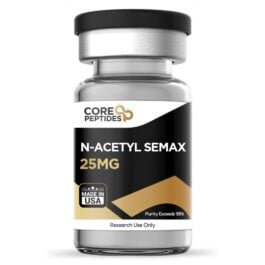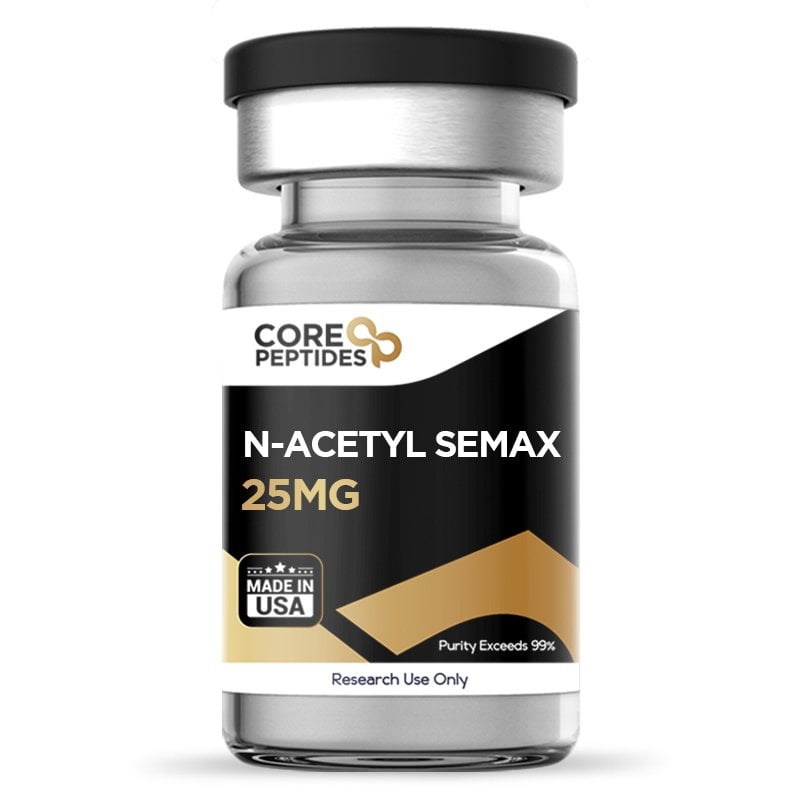
N-Acetyl Semax – 25MG
$60.00
N-Acetyl Semax is the N-acetylated form of Semax, a synthetic analog of the ACTH(4-7) fragment. Content size is 25mg, in the form of lyophilized powder. Peptides are sold for laboratory research use only.
Purity: 99%+ by HPLC (third-party tested)
Tested by: Vanguard Laboratory, see Certificate of Analysis
SKU: N-Acetyl-Semax
Discount per Quantity
| Quantity | Discount | Price |
|---|
| 5 - 8 | 5% | $57.00 | |
| 9 + | 10% | $54.00 |
What Is N-Acetyl Semax?
N-Acetyl Semax is a synthetic polypeptide analogous to the naturally occurring adrenocorticotropic hormone (ACTH). The peptide is similar to a fragment from the adrenocorticotropic hormone ACTH (4-7), specifically Met-Glu-His-Phe, combined with a Pro-Gly-Pro extension at the C-terminus.(1) The addition of Pro-Gly-Pro (PGP) to N-Acetyl Semax might enable an enhanced permeability through the blood-brain barrier (BBB) by increasing the peptide’s lipophilicity via improving passive diffusion or uptake via lipid raft-mediated endocytosis, which may potentially allow it to bypass the tight junctions of the BBB. The PGP addition at the C-terminus might also alter the peptide’s interaction with specific BBB transporters or receptors, possibly promoting receptor-mediated transcytosis. Additionally, the acetylation of the peptide might increase its resistance to enzymatic degradation, prolonging its half-life in experimental models.
How Is N-Acetyl Semax Thought to Work?
N-Acetyl Semax appears to exhibit potential nootropic (memory enhancing) and neuroprotective characteristics, which researchers have proposed may be produced via several routes:
- By potentially interacting with dopamine, serotonin, enkephalin, and brain-derived neurotrophic (BDNF) levels;(2)(3)
- Or by potentially modulating gene expression and increasing the efficacy of the immune system.(4)
Based on studies suggesting that the peptide may inhibit serum enkephalin-degrading enzymes, it is plausible to hypothesize about the interactions between Semax and enkephalins. Researchers suggest Semax’s inhibitory potential on enkephalin-degrading enzymes may lead to an increase in the levels of enkephalins by preventing their degradation. Enkephalins are endogenous opioids that are considered to play roles in nociception and stress response. Further, an increase in enkephalin levels might also influence other neurotransmitter systems due to the complex interplay between the opioid system and neurotransmitters like dopamine and serotonin.(2)
According to studies, Semax may potentially increase the striatal levels of 5-hydroxyindoleacetic acid (5-HIAA), a serotonin metabolite, suggesting a possible enhancement of serotonergic activity. This potential action on serotonin metabolism might amplify serotonin-mediated pathways, possibly influencing central nervous system functioning. On the other hand, Semax does not appear to directly alter dopamine levels or its metabolites. Still, it may modulate the dopaminergic system’s responsiveness, enhancing the dopaminergic agonists’ action.(5)
Specifications(6)
| Name | N-Acetyl Semax |
| Other known names | N-acetyl Semax amidate |
| Sequence | Ac-Met-Glu-His-Phe-Pro-Gly-Pro-NH2 (7 amino acids; N-terminal acetyl, C-terminal amide) |
| Molecular formula | C39H54N10O10S |
| Molecular weight | 855.0 g/mol |
| CAS number | 2920938-90-3 |
| Synthesis | Solid-phase peptide synthesis, US |
| Form | Lyophilized powder |
| Amount per vial | 25 mg |
| Purity | >99% (HPLC) |
| Storage | −20 °C, dry, protected from light |
| SKU | N-Acetyl-Semax |
What Does Research Show About N-Acetyl Semax?
What Does Research Suggest About Nootropic Potential?
Key finding: In rodent models, Semax raised striatal levels of the serotonin metabolite 5-HIAA by 25% after 2 hours and extracellular 5-HIAA gradually up to 180% within 1–4 hours; introduced 20 minutes before D-amphetamine, it strongly enhanced the amphetamine-induced rise in extracellular dopamine and locomotor activity.(5)
A study(5) was conducted on experimental rodents to determine the nootropic potential of ACTH hormone and its analogs, such as Semax. After exposure to Semax, all tested rodents were examined for 5-hydroxyindoleacetic acid (5-HIAA) levels. Based on the results, it was noted that the 5-HIAA levels increased by 25% after just 2 hours following exposure; they increased progressively up to a maximum of 180% after 4 hours. As per Kirill O Eremin et al., “Our results reveal the positive modulatory [action] of Semax on the striatal serotonergic system and the ability of Semax to enhance both the striatal release of dopamine and locomotor behavior elicited by D-amphetamine.”
In another research study,(7) experimental models under excessive stress conditions were exposed to Semax. Upon analyzing behavior 24 hours after peptide exposure, it was noted that they appeared to show signs of enhanced memory and attention. As per the reports, “In the majority of cases, the peptide exhibited positive [actions], and in no case did it produce negative side actions or complications connected with its administration. There is good reason to believe that … potentialities of Semax have not been exhausted and in the future new possibilities … will be revealed.” The study is shared here for educational and research purposes, and studies on the Semax peptide are still being conducted.
How May Semax Affect Behavior After Early SSRI Exposure?
Key finding: In lab models exposed to the SSRI fluvoxamine on postnatal days 1–14, Semax on days 15–28 reduced anxiety-like behavior, improved learning and normalized the brain monoamine levels altered by the early SSRI exposure.(8)
Selective Serotonin reuptake inhibitors (SSRIs) are a class of antidepressants. In pregnant research models, the compounds may risk passing through the placenta and impacting fetal brain development. In a preclinical research study,(8) experimental rats aged between 1 and 14 days were presented first with an SSRI compound, followed by the Semax peptide. After 4 weeks, it was observed that the rats exposed to SSRIs showcased anxious behavior, especially when exposed to new stimuli. When they were given the Semax peptide, these same rats later reportedly exhibited a reduction in their anxiety levels and potential enhancement in their learning abilities.
What Do Maternal Separation Models Suggest?
Key finding: In lab models separated from their mothers for 5 hours a day on postnatal days 1–14, Semax on days 15–28 normalized anxiety levels at one month of age and lessened the effect of the deprivation on body weight.(9)
Young offspring face separation anxiety when they are away from their mothers. Separating for a prolonged period may lead to impaired emotional reactivity. A research study(9) examined young rats facing maternal deprivation. After four weeks of separation from their mothers, these rats reportedly exhibited increased anxiety and excessive physical activity. When the rats were presented with Semax, their reactions improved, indicating reduced anxiety. As per M. A. Volodina et al., these results suggest that “Semax [weakens] the impact of deprivation on animal body weight and [normalizes] the levels of anxiety in rats.”
How May Semax Affect the Cardiovascular System?
Key finding: In lab models examined 28 days after myocardial infarction, early exposure to Semax partially prevented the rise in left ventricular end-diastolic pressure and lessened cardiomyocyte hypertrophy and the imbalance between contractile and mitochondrial growth, without changing cardiac work.(10)
For this study,(10) rodents were induced with myocardial infarction (MI), which may lead to vascular damage. These rodents were then divided into two groups – one was given Semax peptide for six days, and the second was given a placebo. Following 28 days after the occurrence of myocardial infarction, it was reported by the researchers that the control rodents appeared to exhibit reduced arterial blood pressure and cardiac hypertrophy, both of which may signal impending heart failure. In contrast, the peptide-exposed rodents reportedly exhibited signs indicating preventing diastolic pressure growth in the left ventricle, which may indicate possible remodeling of the heart ventricle and inhibition of heart failure.
What Does Research Suggest About Neuroprotection?
In a clinical study,(11) research models of ischemic strokes were evaluated for 10 days. Of these, 30% were presented with conventional compounds and the Semax peptide, while the remaining 70% were presented with conventional compounds only. After 10 days, all models were examined via electroencephalogram (EEG). Based on the EEG mapping, the researchers reported that the experimental group exposed to both the peptide and compound exhibited apparently notable improvement in restoring damaged brain activity.
Certificate of Analysis
| Batch / lot | C74589 |
| Test date | 4/28/2026 |
| Testing laboratory | Vanguard Laboratory |
| Method | HPLC-UV/VIS (purity) |
| Purity result | >99.80% |
| Full report | Download the N-Acetyl Semax COA (PDF) |
N-Acetyl Semax peptide is available for research and laboratory purposes only. We offer free shipping in the US for orders over $200. Please review our Terms and Conditions before ordering.
Frequently Asked Questions
What is N-Acetyl Semax?
N-Acetyl Semax is a modified form of Semax, the synthetic heptapeptide Met-Glu-His-Phe-Pro-Gly-Pro built on the ACTH(4-7) fragment with a Pro-Gly-Pro extension. Its N-terminus is acetylated, and PubChem lists it with a C-terminal amide (N-acetyl Semax amidate).
How does N-Acetyl Semax differ from Semax?
N-Acetyl Semax carries an acetyl group at the N-terminus and an amide at the C-terminus, changes that researchers suggest may increase its resistance to enzymatic breakdown. The studies summarized on this page were carried out with Semax.
What is the molecular weight of N-Acetyl Semax?
N-Acetyl Semax (N-acetyl Semax amidate) has the molecular formula C39H54N10O10S and a molecular weight of approximately 855.0 g/mol.
How should N-Acetyl Semax be stored?
Lyophilized N-Acetyl Semax should be stored at −20 °C, dry and protected from light.
Is N-Acetyl Semax third-party tested?
Yes. The current batch (C74589) was tested by a third-party laboratory and showed >99% purity by HPLC. Its certificate of analysis is available on this page.
References:
- Kolomin, T., et al. (2013). A new generation of drugs: Synthetic peptides based on natural regulatory peptides. Neuroscience & Medicine, 4(4), 223–252. https://doi.org/10.4236/nm.2013.44035
- Kost, N. V., Sokolov, O. I., Gabaeva, M. V., Grivennikov, I. A., Andreeva, L. A., Miasoedov, N. F., & Zozulia, A. A. (2001). [Semax and selank inhibit the enkephalin-degrading enzymes from human serum]. Bioorganicheskaia khimiia, 27(3), 180–183. https://doi.org/10.1023/a:1011373002885
- Tsai, S. J. (2007). Semax, an analogue of adrenocorticotropin (4-10), is a potential agent for the treatment of attention-deficit hyperactivity disorder and Rett syndrome. Medical hypotheses, 68(5), 1144–1146. https://doi.org/10.1016/j.mehy.2006.07.017
- Medvedeva, E. V., Dmitrieva, V. G., Povarova, O. V., Limborska, S. A., Skvortsova, V. I., Myasoedov, N. F., & Dergunova, L. V. (2014). The peptide semax affects the expression of genes related to the immune and vascular systems in rat brain focal ischemia: genome-wide transcriptional analysis. BMC genomics, 15, 228. https://doi.org/10.1186/1471-2164-15-228
- Eremin, K. O., Kudrin, V. S., Saransaari, P., Oja, S. S., Grivennikov, I. A., Myasoedov, N. F., & Rayevsky, K. S. (2005). Semax, an ACTH(4-10) analogue with nootropic properties, activates dopaminergic and serotoninergic brain systems in rodents. Neurochemical research, 30(12), 1493–1500. https://doi.org/10.1007/s11064-005-8826-8
- National Center for Biotechnology Information (2026). PubChem Compound Summary for CID 172638603, N-acetyl semax amidate. PubChem. https://pubchem.ncbi.nlm.nih.gov/compound/172638603
- Asmarin, I. P., Nezavibat’ko, V. N., Miasoedov, N. F., Kamenskiĭ, A. A., Grivennikov, I. A., Ponomareva-Stepnaia, M. A., Andreeva, L. A., Kaplan, A. I., Koshelev, V. B., & Riasina, T. V. (1997). [A nootropic adrenocorticotropin analog 4-10-semax (15 years experience in its design and study)]. Zhurnal vysshei nervnoi deiatelnosti imeni I P Pavlova, 47(2), 420–430. https://pubmed.ncbi.nlm.nih.gov/9173745/
- Glazova, N. Y., Manchenko, D. M., Volodina, M. A., Merchieva, S. A., Andreeva, L. A., Kudrin, V. S., Myasoedov, N. F., & Levitskaya, N. G. (2021). Semax, synthetic ACTH(4-10) analogue, attenuates behavioural and neurochemical alterations following early-life fluvoxamine exposure in white rats. Neuropeptides, 86, 102114. https://doi.org/10.1016/j.npep.2020.102114
- Volodina, M. A., Sebentsova, E. A., Glazova, N. Y., Levitskaya, N. G., Andreeva, L. A., Manchenko, D. M., Kamensky, A. A., & Myasoedov, N. F. (2012). Semax attenuates the influence of neonatal maternal deprivation on the behavior of adolescent white rats. Bulletin of experimental biology and medicine, 152(5), 560–563. https://doi.org/10.1007/s10517-012-1574-2
- Gavrilova, S. A., Golubeva, A. V., Lipina, T. V., Fominykh, E. S., Shornikova, M. V., Postnikov, A. B., Andrejeva, L. A., Chentsov, I. S., & Koshelev, V. B. (2006). [Protective effect of peptide semax (ACTH(4-7)Pro-Gly-Pro) on the rat heart rate after myocardial infarction]. Rossiiskii fiziologicheskii zhurnal imeni I.M. Sechenova, 92(11), 1305–1321. https://pubmed.ncbi.nlm.nih.gov/17385423/
- Gusev, E. I., Skvortsova, V. I., Miasoedov, N. F., Nezavibat’ko, V. N., Zhuravleva, E. I., & Vanichkin, A. V. (1997). [Effectiveness of semax in acute period of hemispheric ischemic stroke (a clinical and electrophysiological study)]. Zhurnal nevrologii i psikhiatrii imeni S.S. Korsakova, 97(6), 26–34. https://pubmed.ncbi.nlm.nih.gov/11517472/
Related reading: Semax research: neuroprotective and gastric studies.